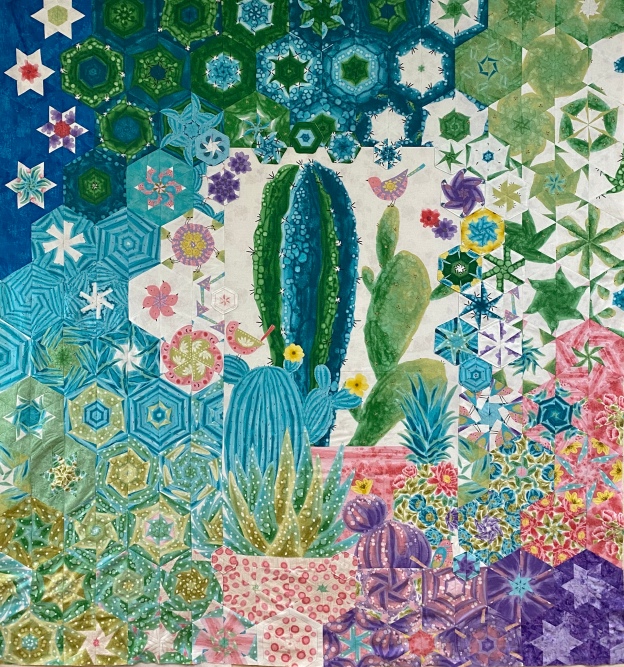
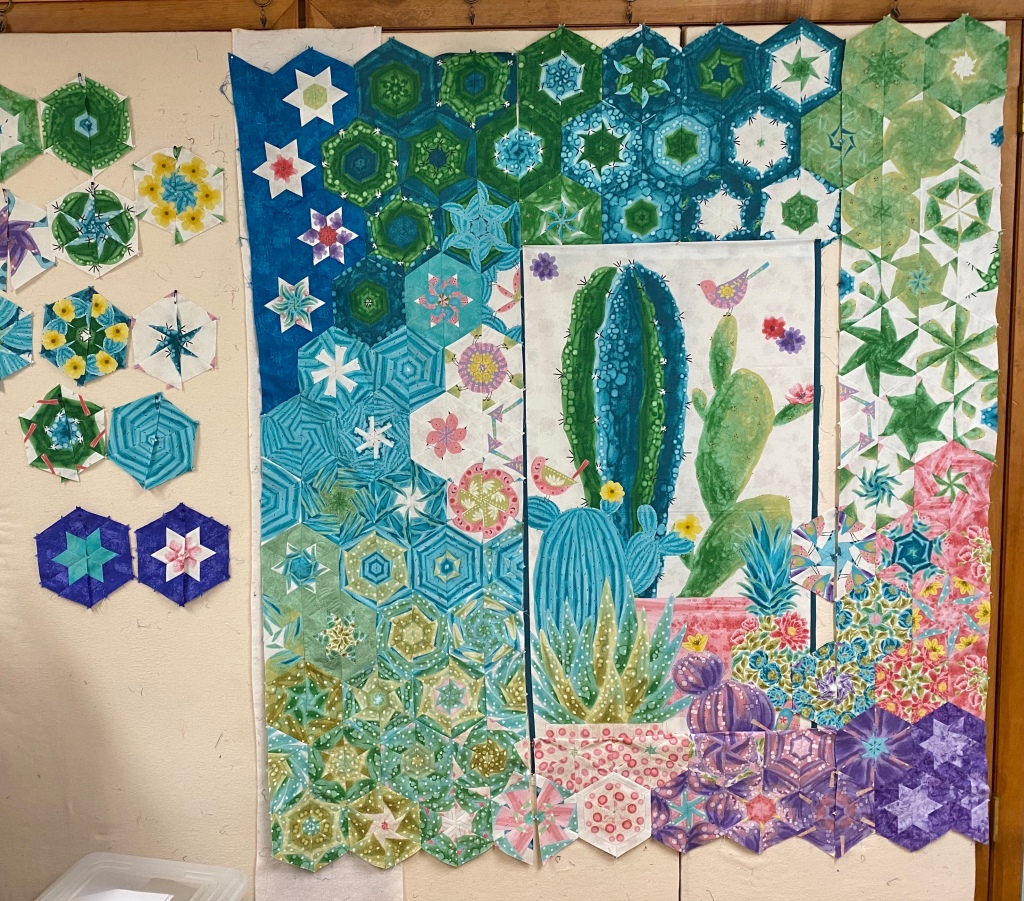
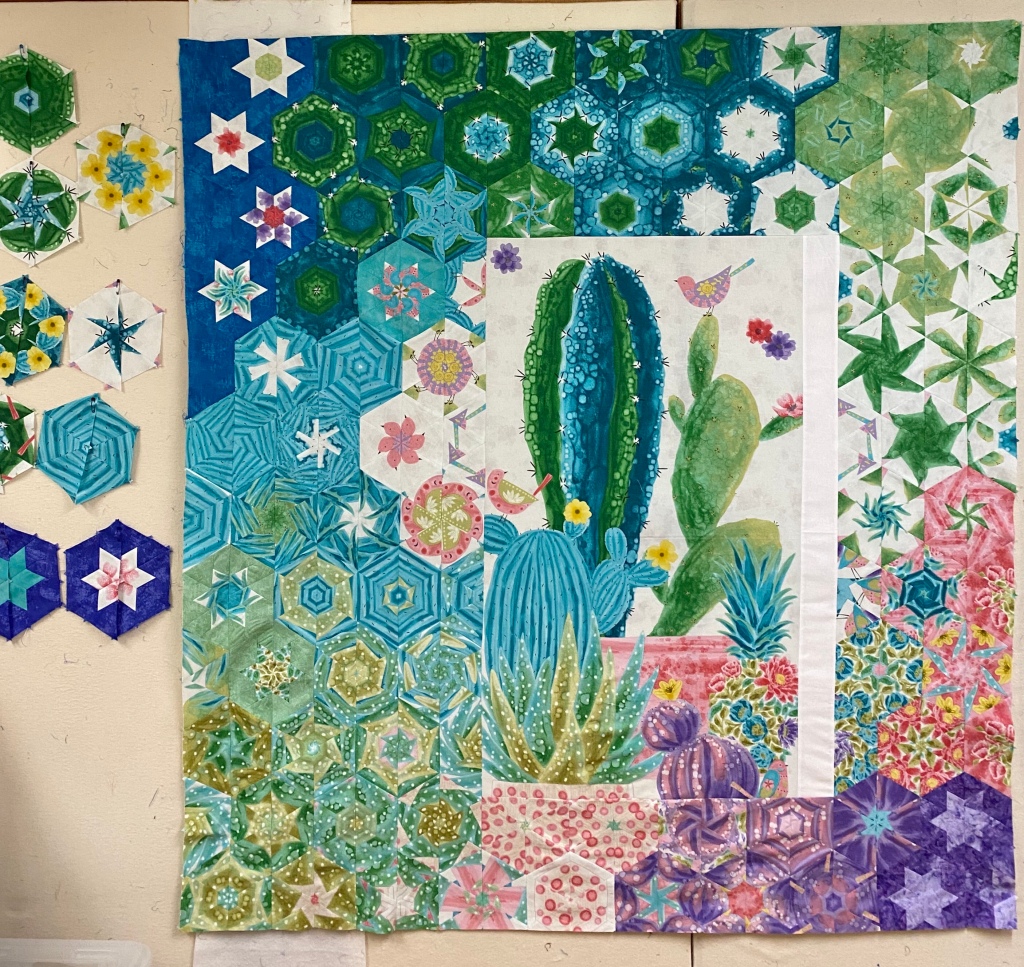
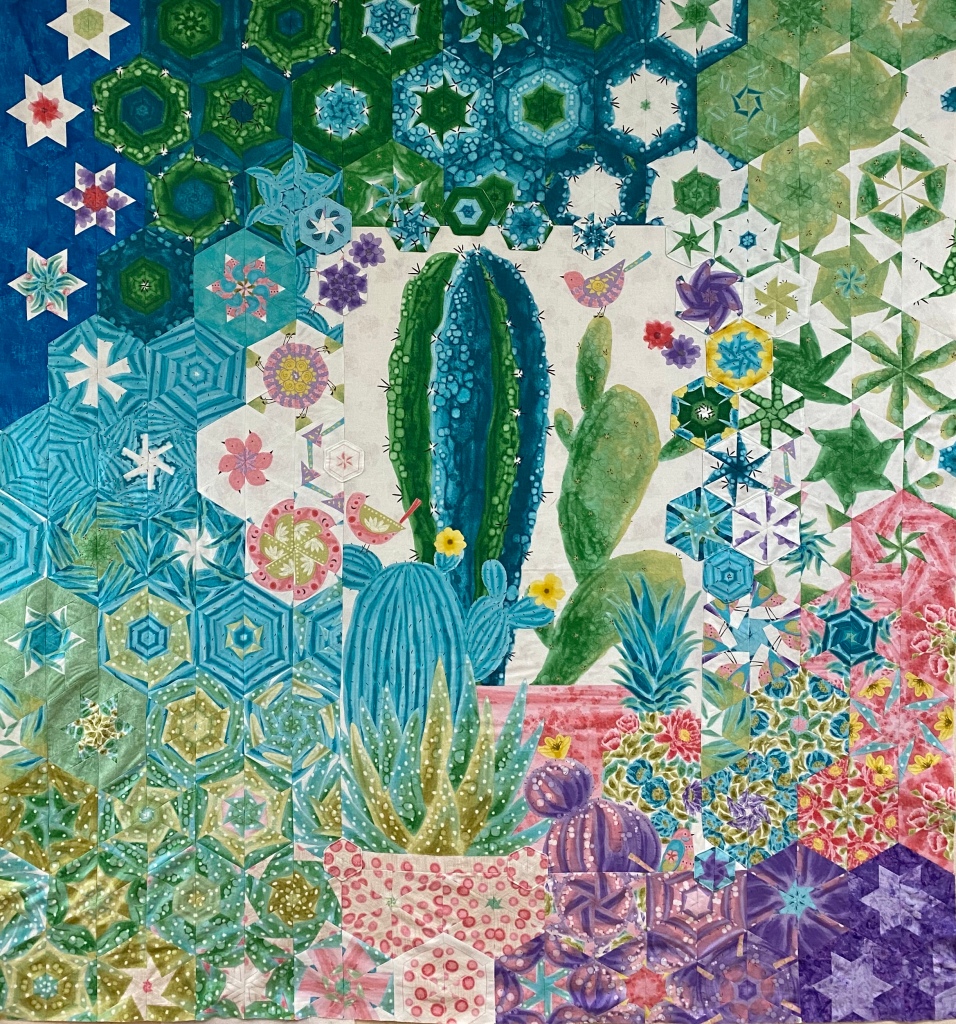
Yes, I’m at it again! Actually I’ve had this panel cut out since last Fall. I love One Block Wonders (OBWs). Sometimes I add cubes to create design interest or just for fun. It occurred to me that Studio 180 Design has a new Star 60 tool.
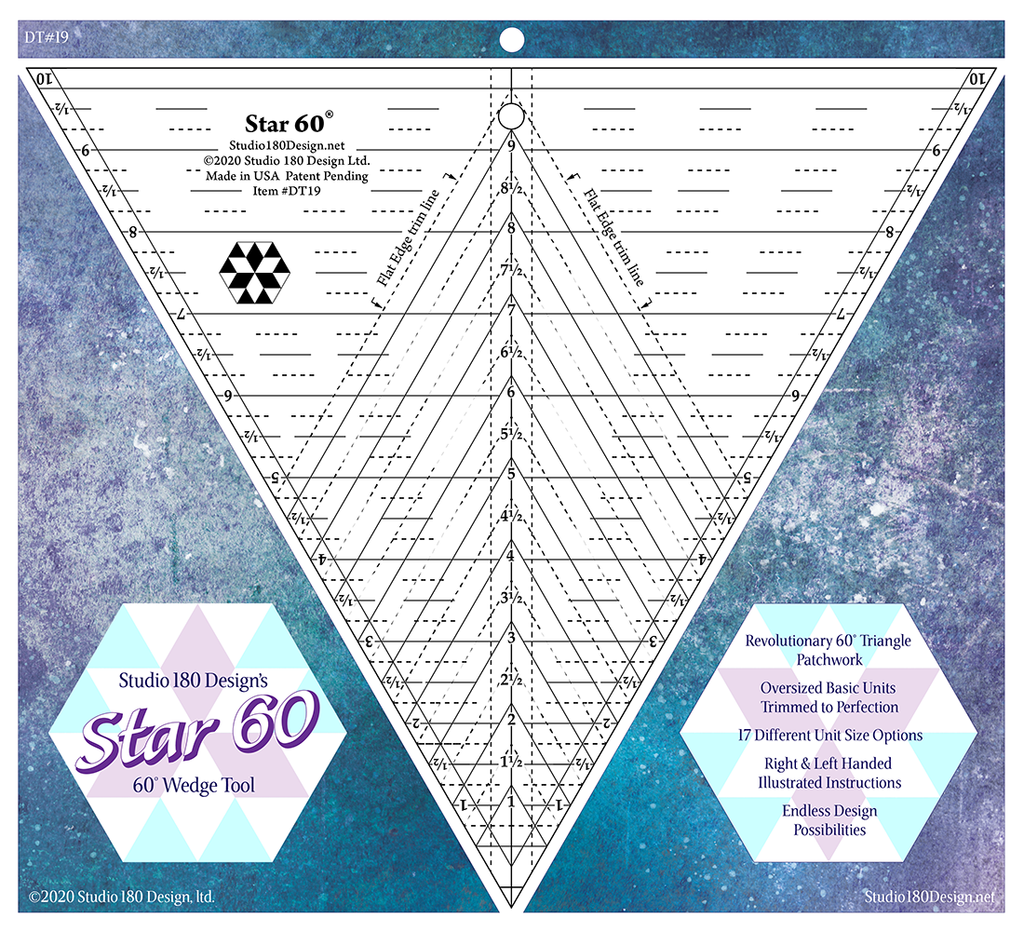
You can use this tool to cut equilateral triangles easily, along with 60 degree diamonds and side triangles in 17 sizes to create a multitude of 60 degree designs.
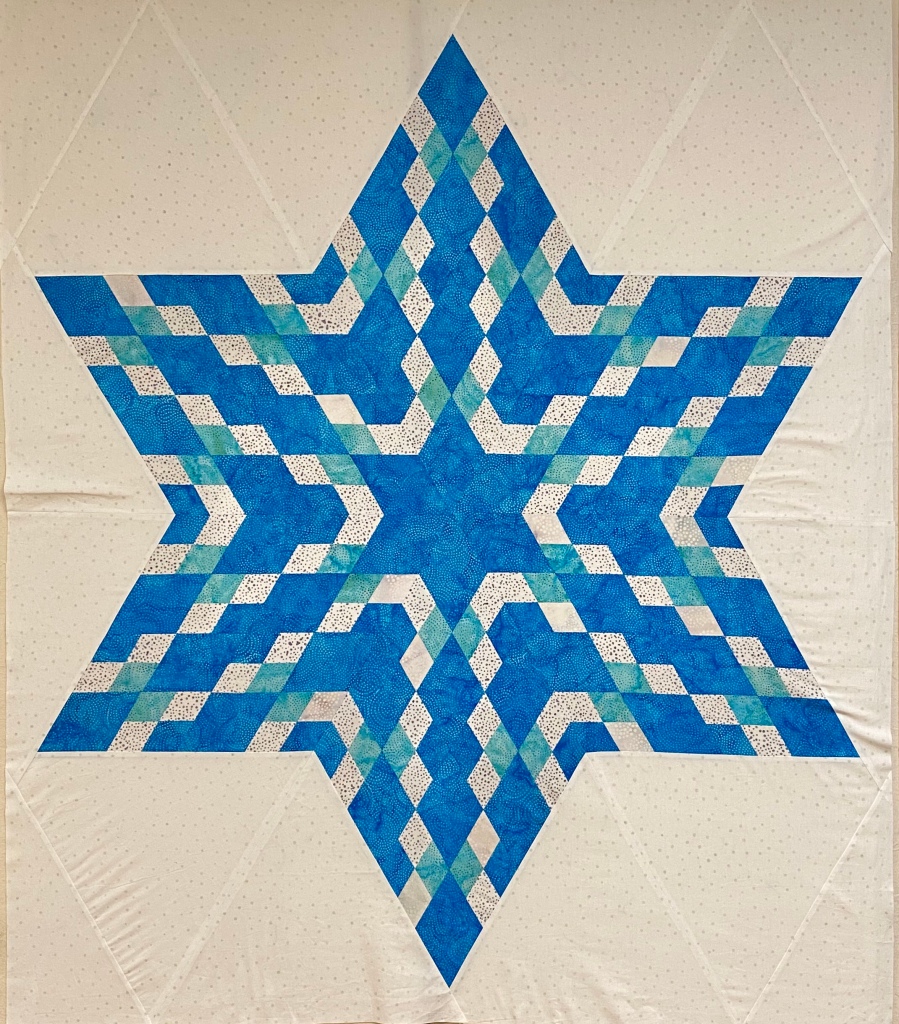
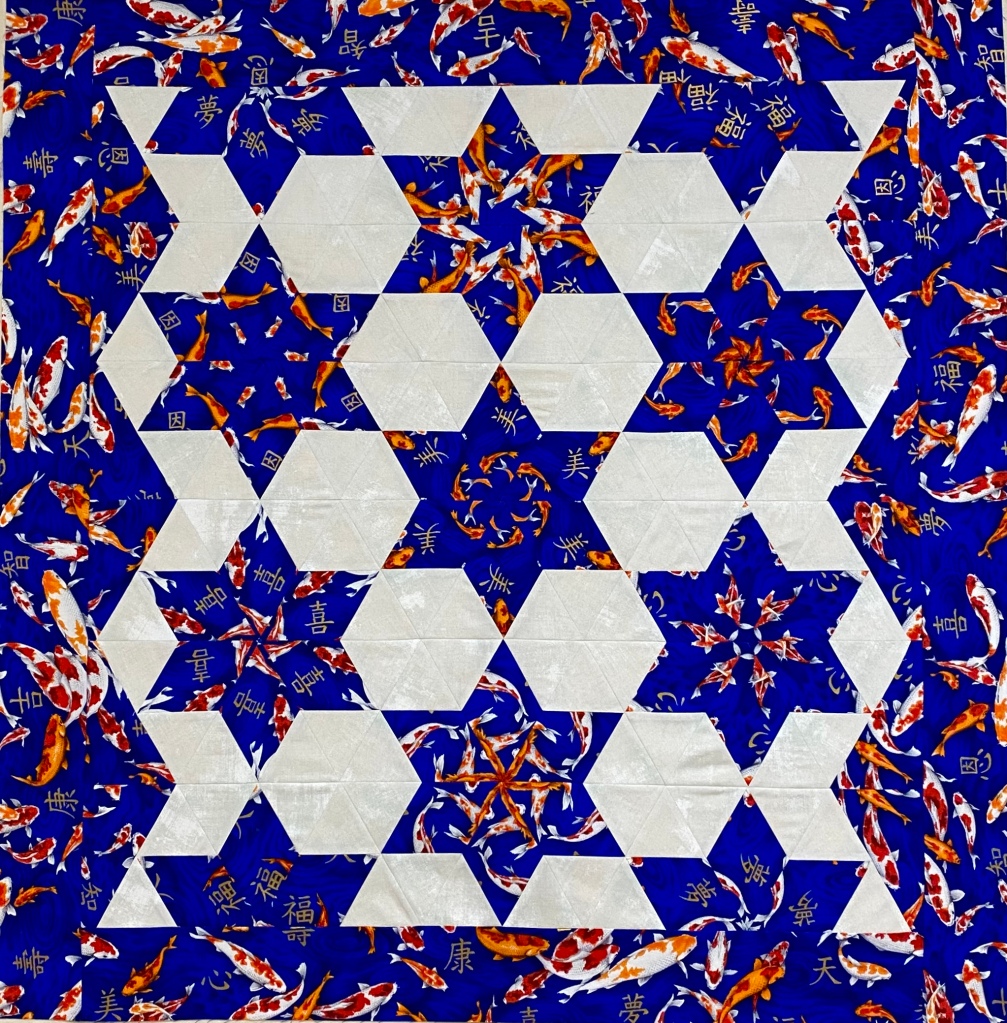
I played with Star 60 and created kaleidoscope stars and this 48″ star. Light Bulb moment!!!! Instead of inserting cubes in my OBW, why not a star?
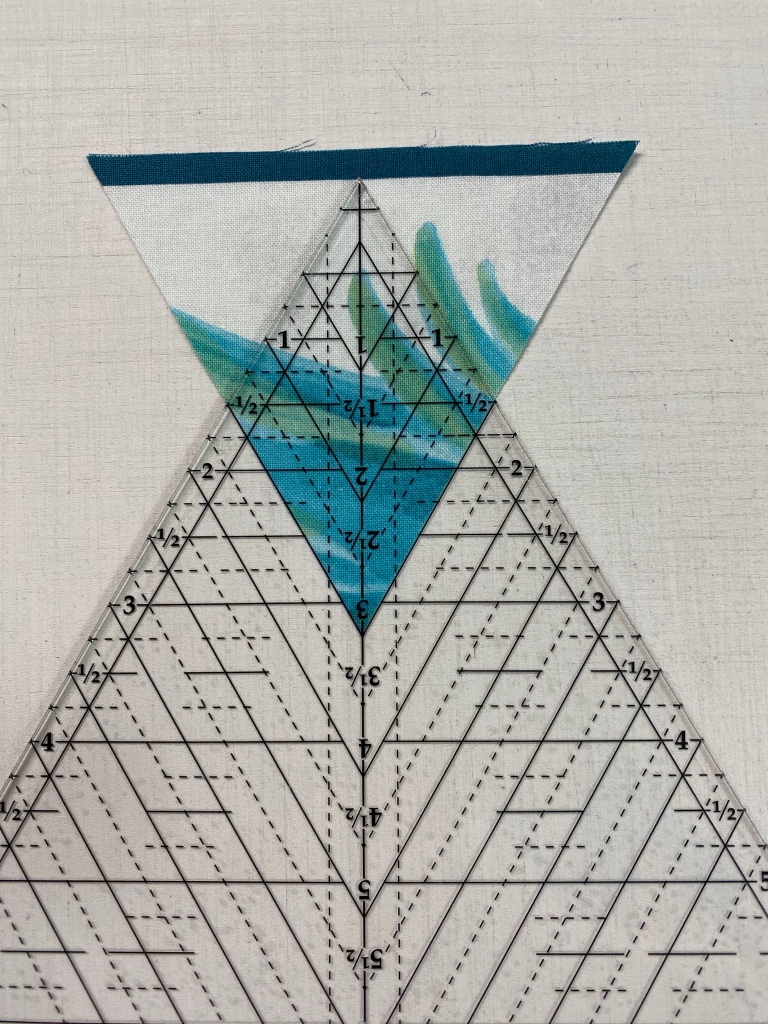
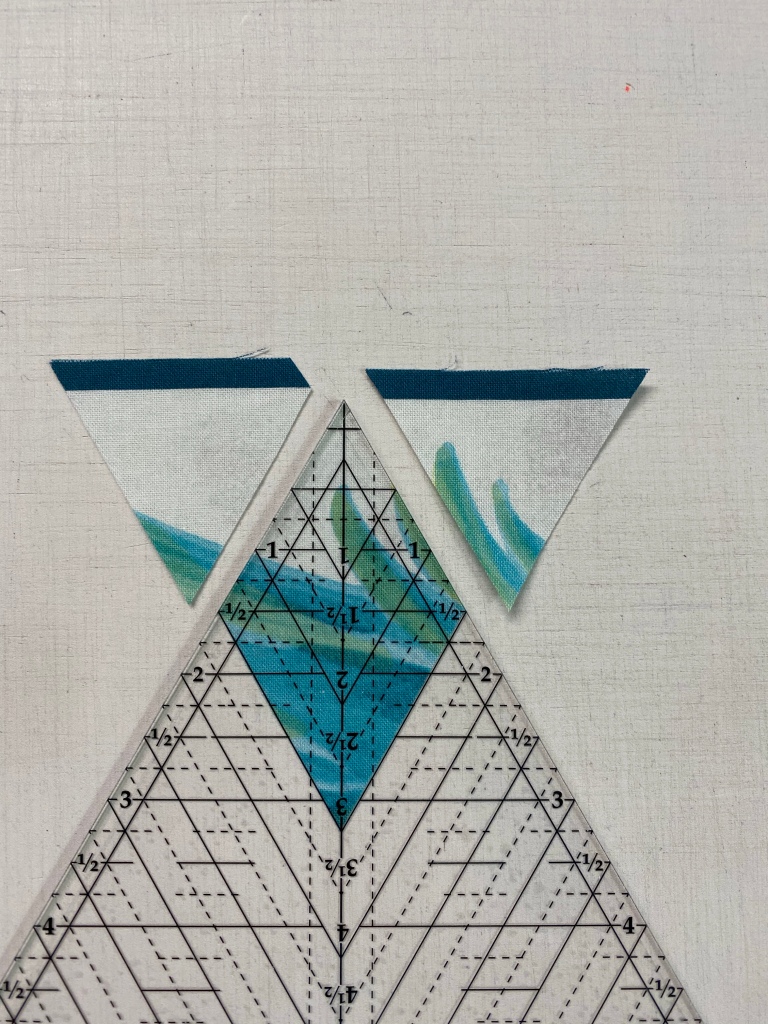
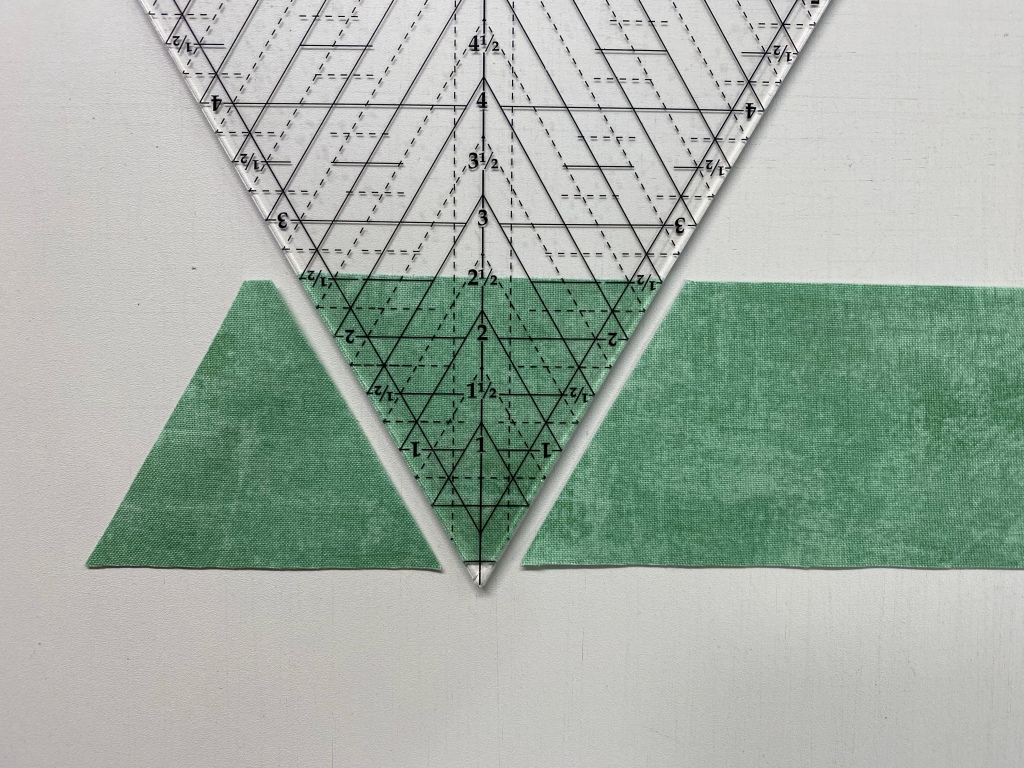
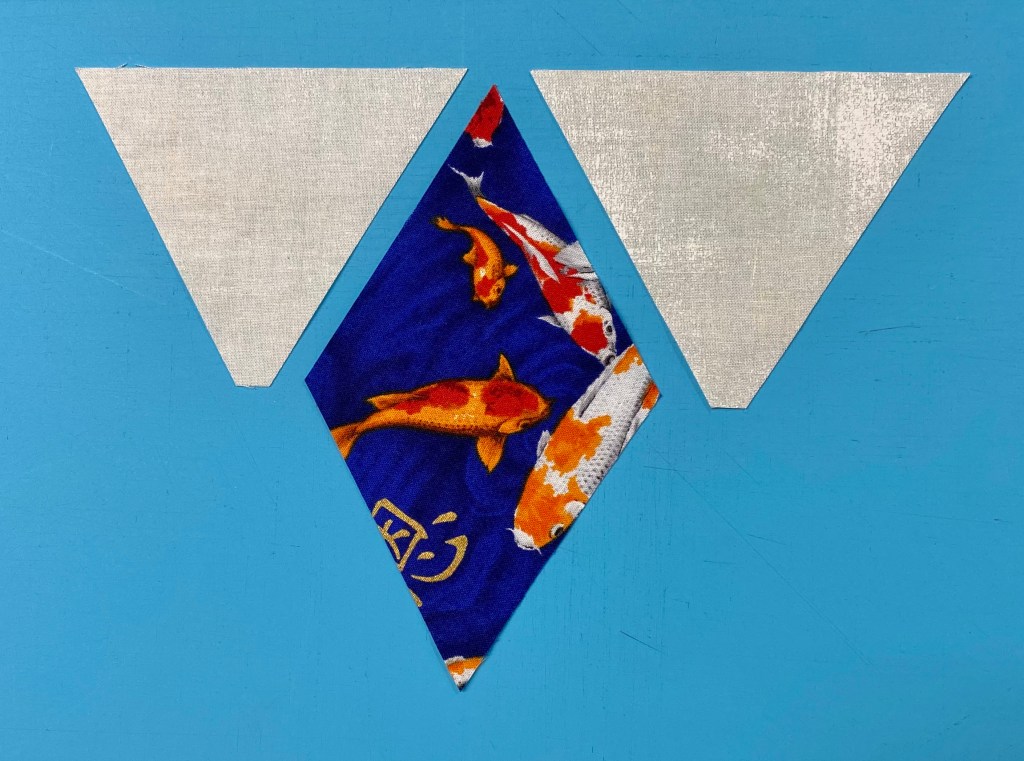
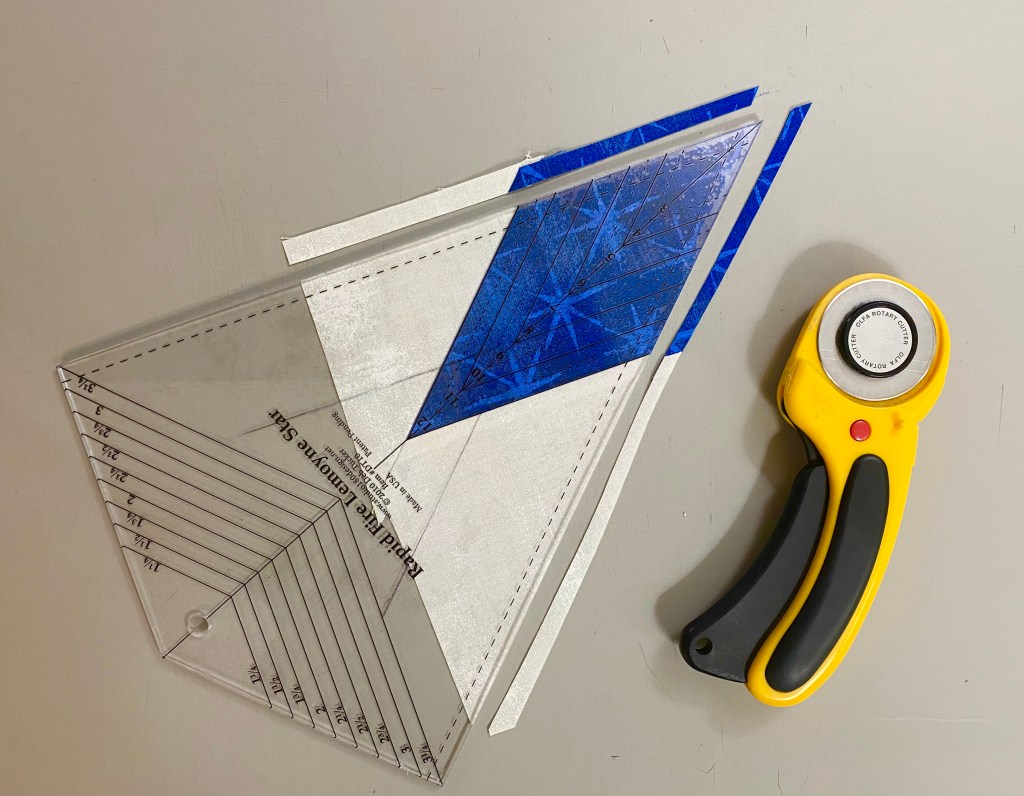
I usually have left over triangles when designing my OBW’s. I had equilateral triangles cut that had a dark edge that was larger than a 1/4″. I was thought it might not make a pretty hexie. These triangles had been cut from 3 3/4″ strips. I laid my Star 60 tool on the triangles and discovered I could cut 3″ diamonds from it. This allowed me to use these left over triangles in a different way.
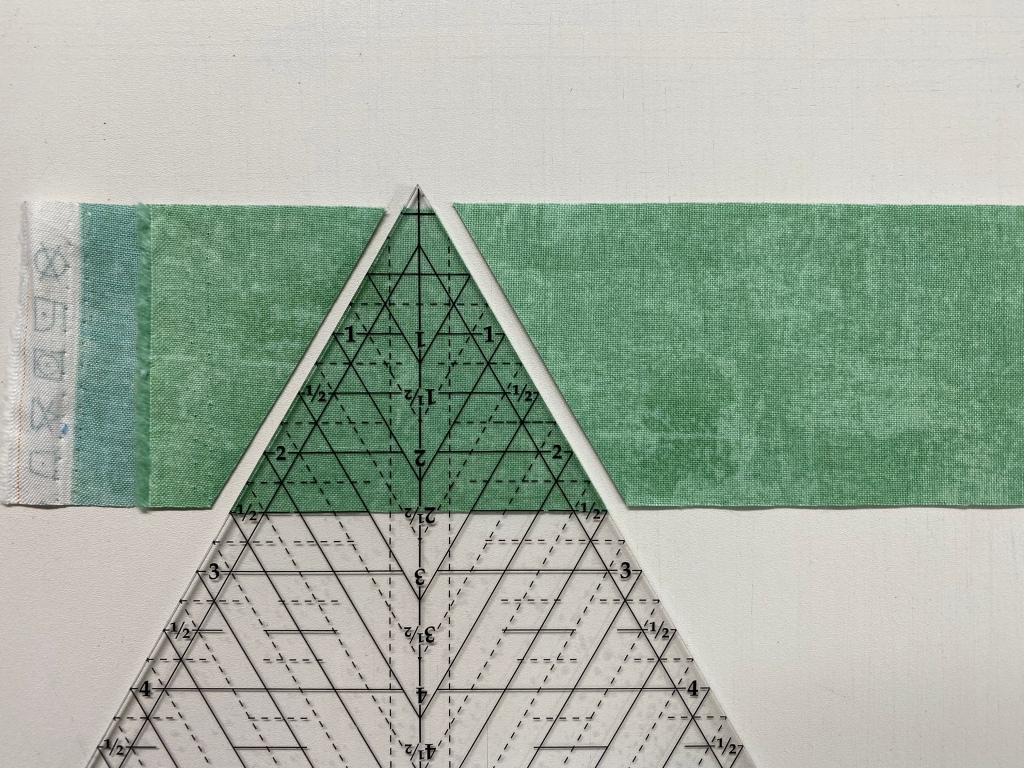
Way cool! Now I needed side triangles for the star points. I checked the size chart for 3″ diamonds and cut the appropriate size strip,
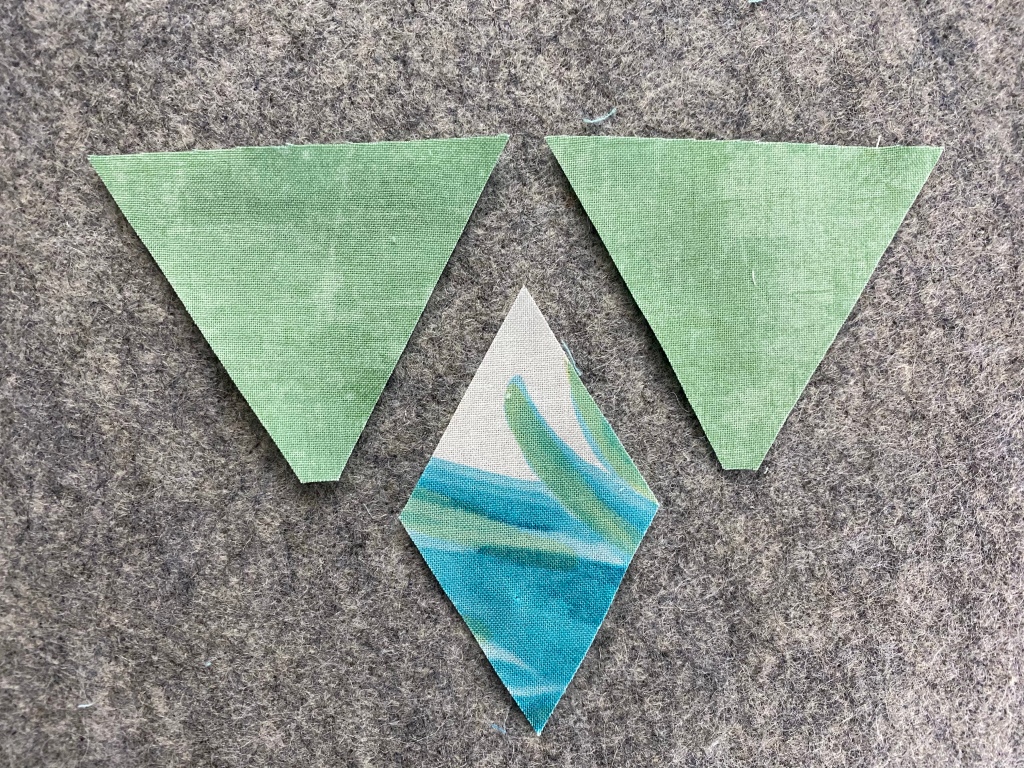
I cut the side triangles for my diamond star points.
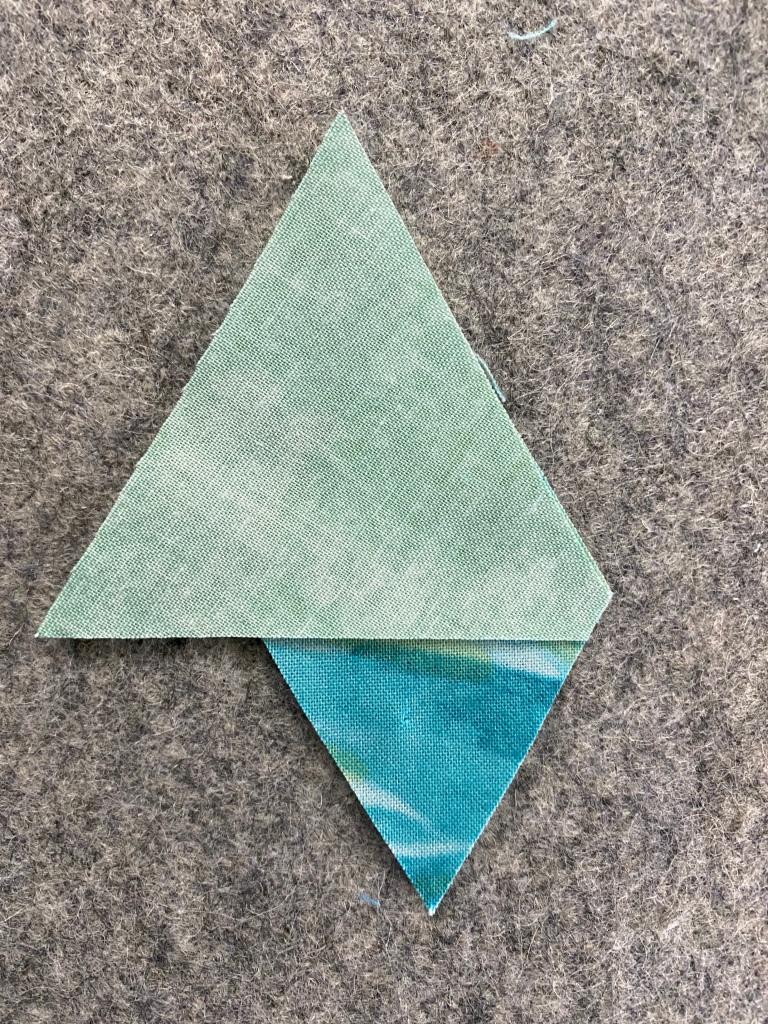
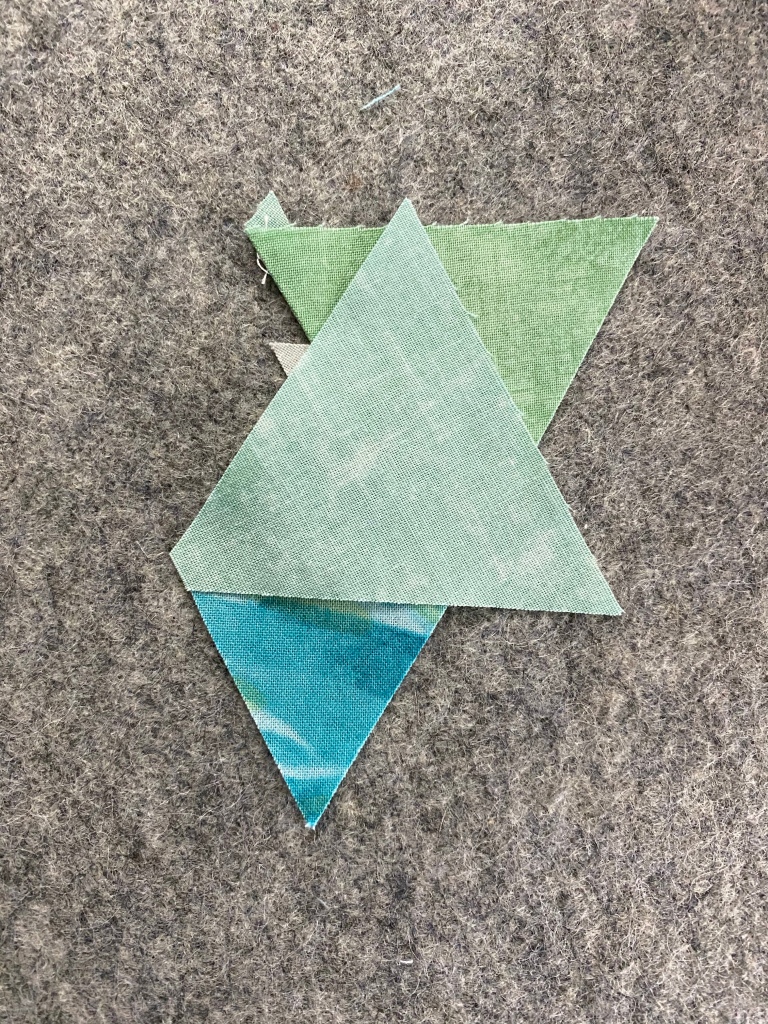
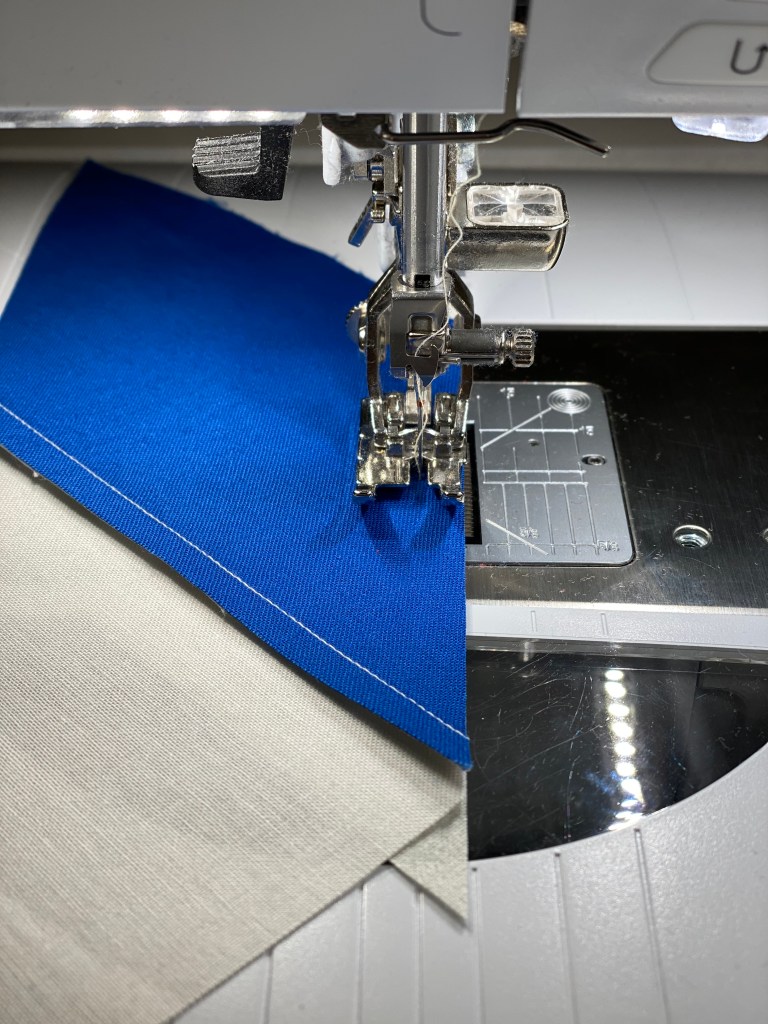
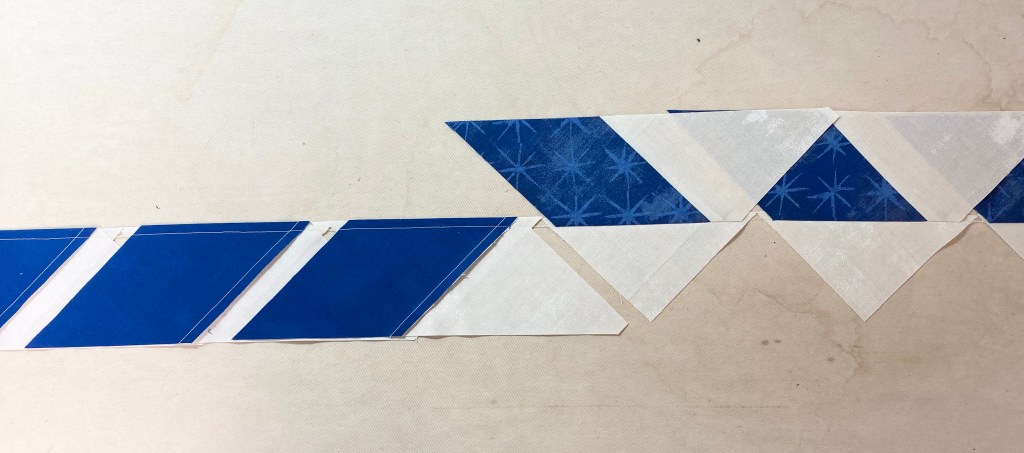
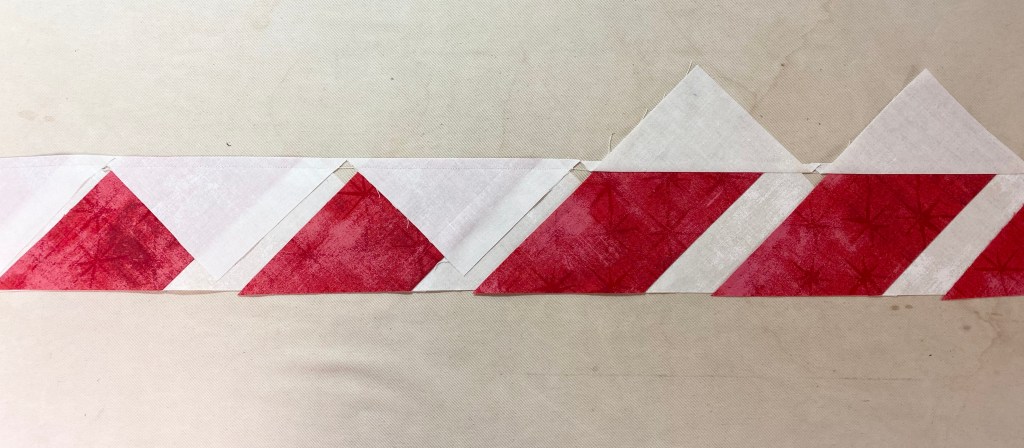
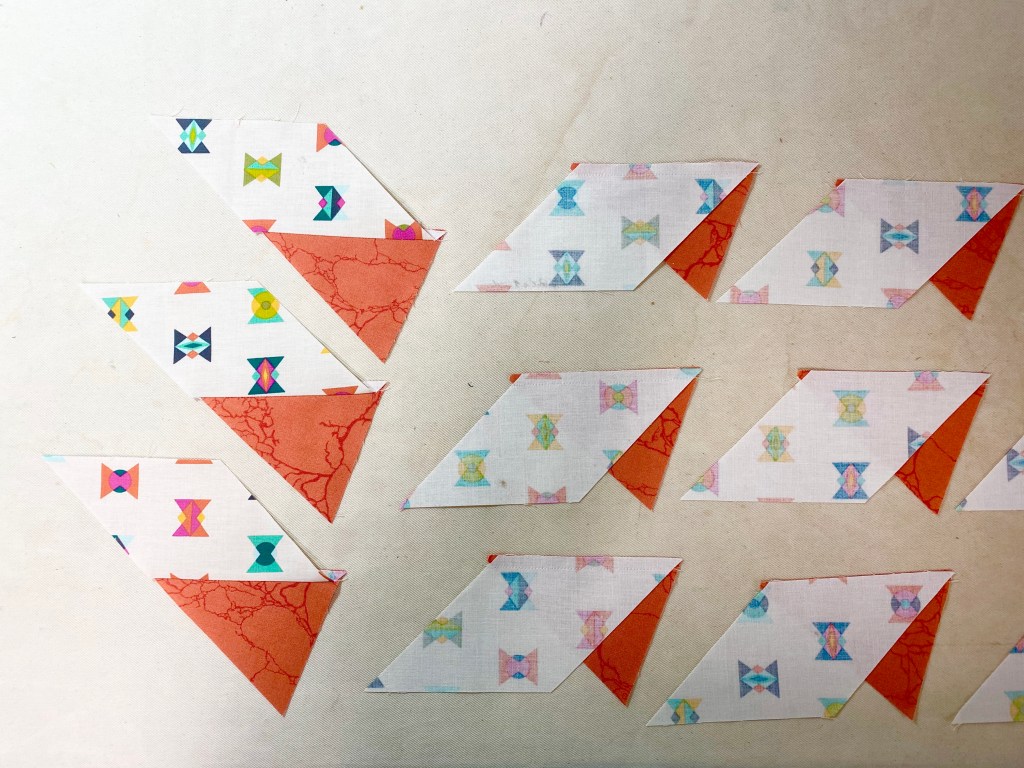
Lay out your units. Stitch the first side triangle to the diamond and press toward the diamond.
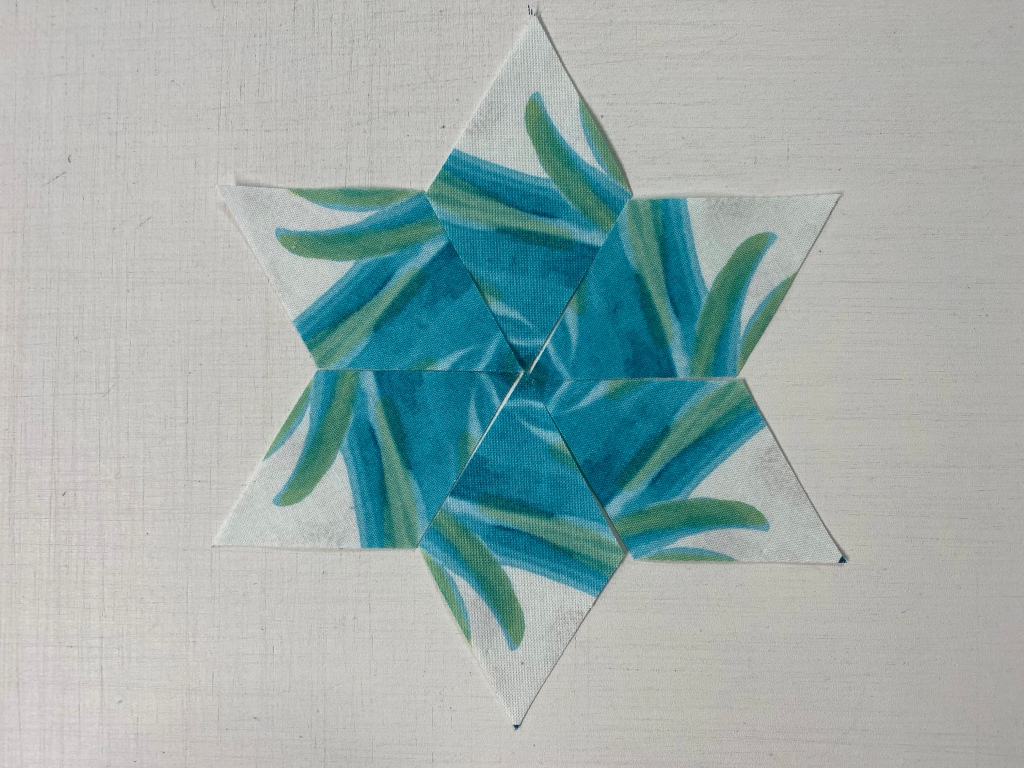
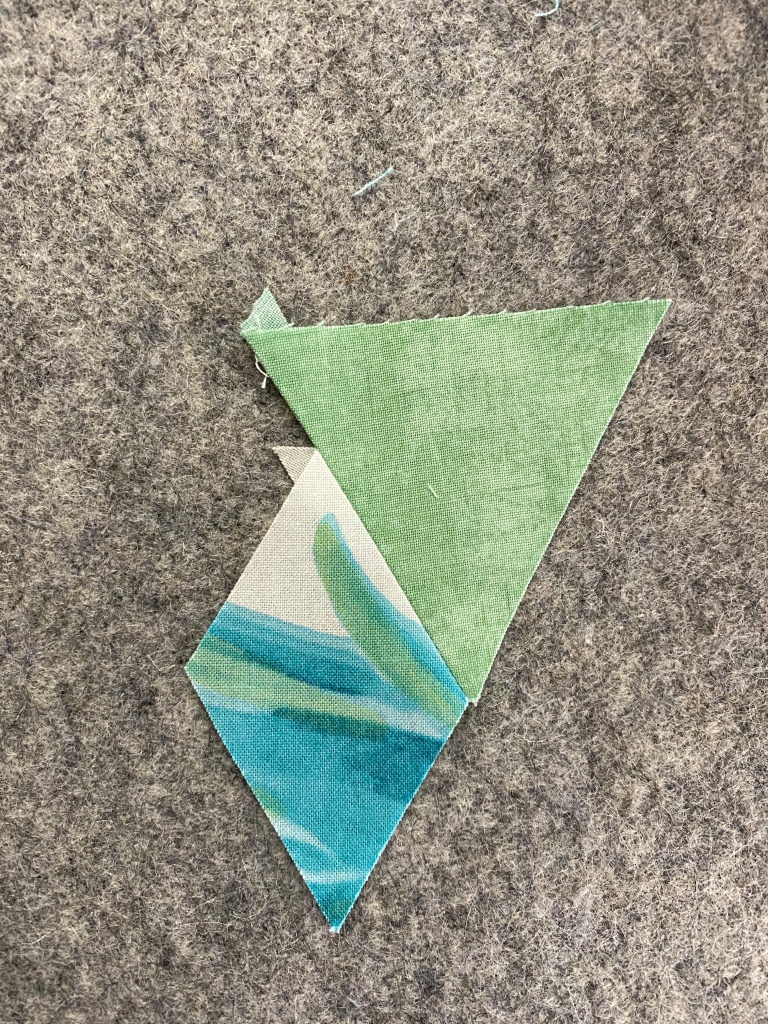
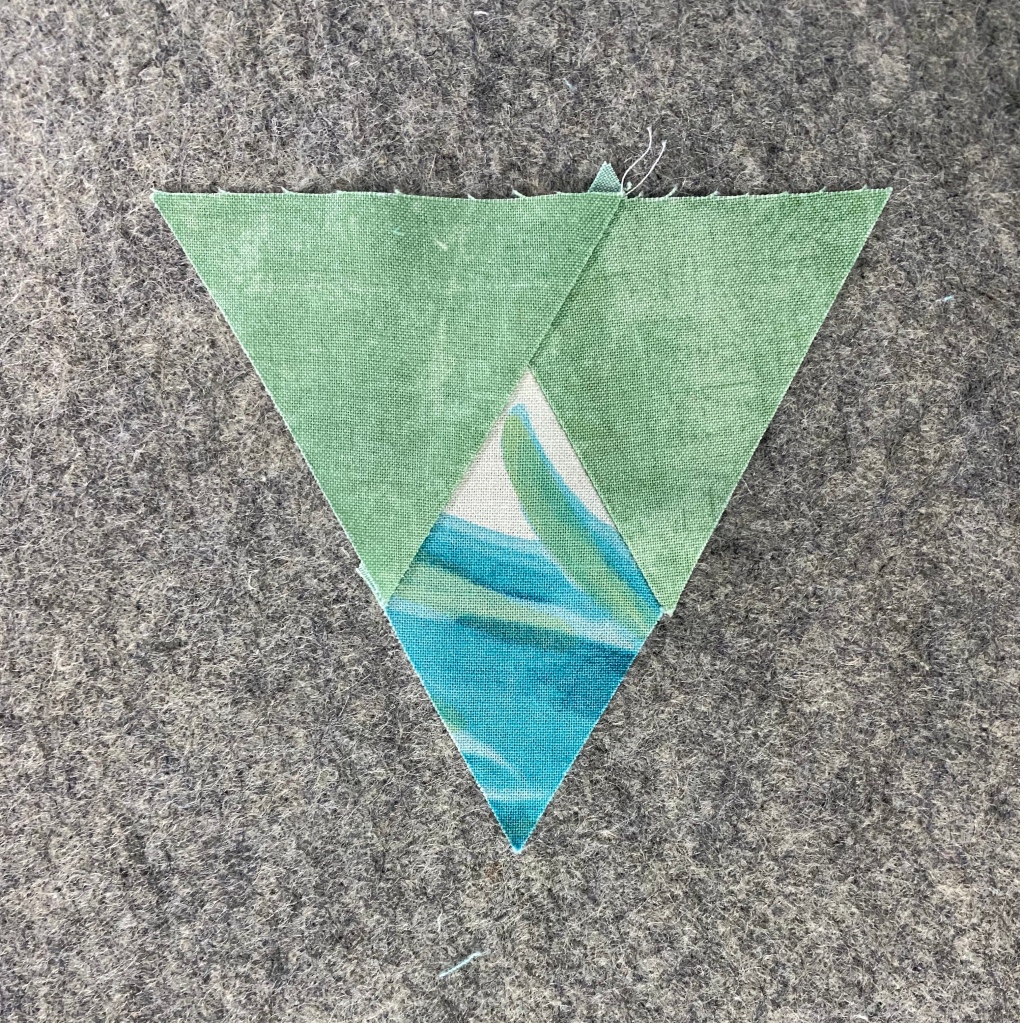
Stitch the opposite side triangle, press toward the side triangle. LOOK what you have! An equilateral triangle.
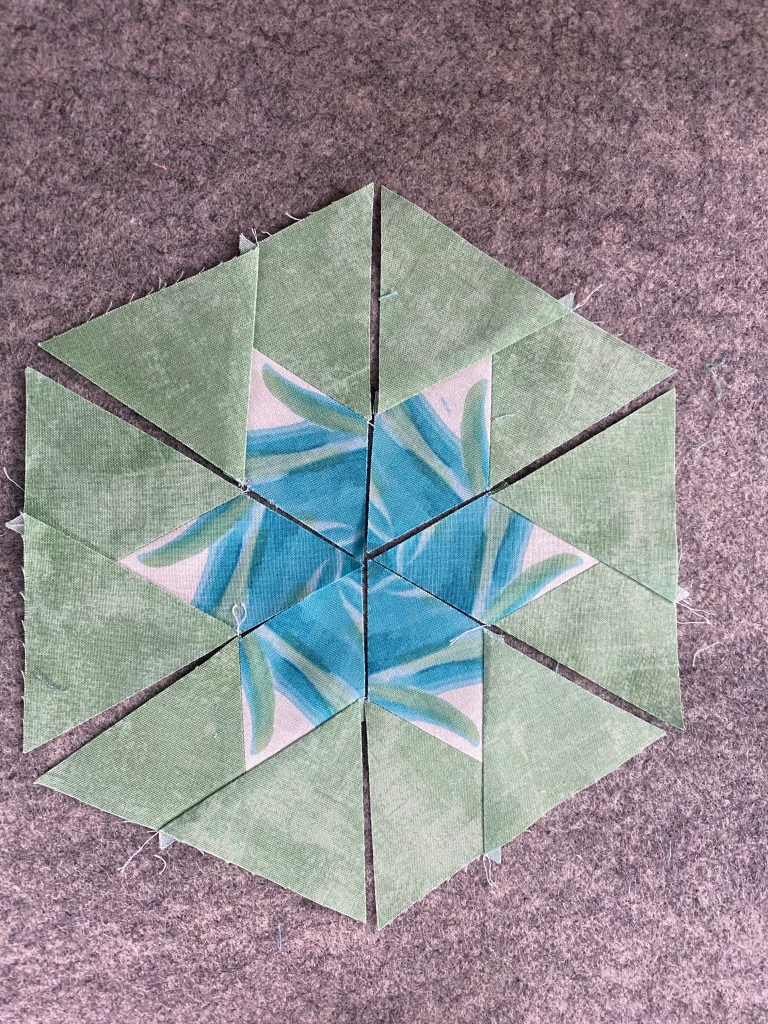
Stitch 3 triangles together, and then the other 3 together, press seams open as you would a regular hexagon.
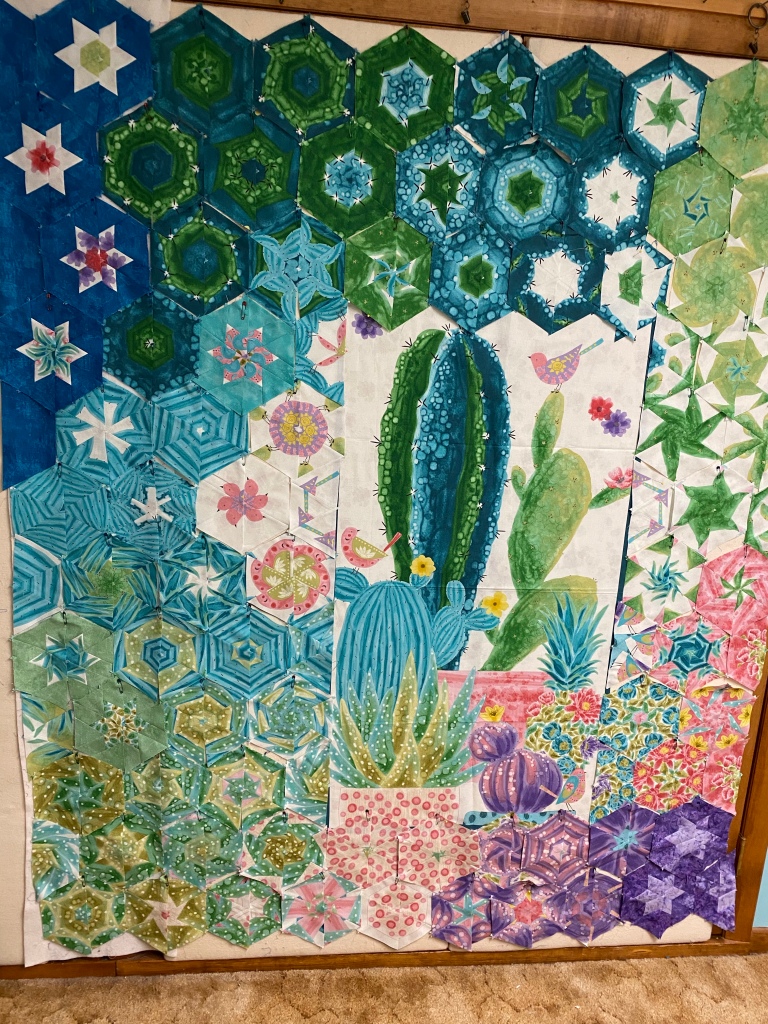
I began designing around my panel. I had great fabric “Canvas” from Northcott. This rich colors worked so well with panel.
I have stitched my hexie’s into four sections to add to my panel. My hexies were cut from 3 3/4″ strips, which means they will finish as a 6″ hexagon. For 6″ hexies to fit evenly across the width this panel should measure 18″ or 24″ wide. This panel is less than 24″ wide.
I did not want to trim my panel to 18″ so I added enough fabric to the panel to bring it up to 24″ wide and would be evenly divisible by 6″. Now to hide the strip.
There are 9 & a 1/2 Star 60 hexie’s in this quilt. The Star 60 tool also made it easy to cut half & whole hexagons. I’ve just barley scratched the surface of cool 60 degree design’s that can be added to a One Block Wonder. You can download my hints for using panels in a OBW below:
Stitchin Heaven Quilt Shop is excited to announce a new collaboration of a unique BOM program from Deb Tucker (Studio 180 Design), NYT and USA Today best-selling author Marie Bostwick (Between Heaven and Texas, Hope on the Inside, and the Cobbled Court Quilt Series, including A Single Thread), Deb Luttrell (Stitchin’ Heaven), and Jason Yenter (In the Beginning Fabrics). In this 12-month program you will take your own Journeys through an exclusive novella written by Marie Bostwick. Each month you will receive a chapter from the book which is exclusive to this program. It is a page-turning tale of love, loss, and new beginnings for PJ Lloyd, an adventurous young woman who defies her family and risks her future to make a difference after the attack that plunged America into the second World War.
I will be your guide on this “Journey”. Every month I will post a tutorial showing you how to use the tools required for this beautiful quilt and answering your questions.
Throughout the Journeys BOM you will be on your own journey to learn how to use 8 of the tools from Studio 180 Design. Tools include: V Block, Corner Pop, Four-patch Square Up, Tucker Trimmer, Rapid Fire Lemoyne Star, Square Squared, Wing Clipper, Corner Beam. The final quilt measures 102″ x 102″. A beautiful collection of fabrics have been designed by Jason Yenter of In The Beginning Fabrics, that will make this project an heirloom favorite.
I tested the pattern with fabrics from Deb Tucker’s stash. It is truly a beautiful quilt I can’t wait for you to make your own! The Journey’s BOM program is due to start in September 2020. We will be sure to keep you up to date and informed on all the details.
A conversation with Deb Luttrell, Deb Tucker & Marie Bostwick
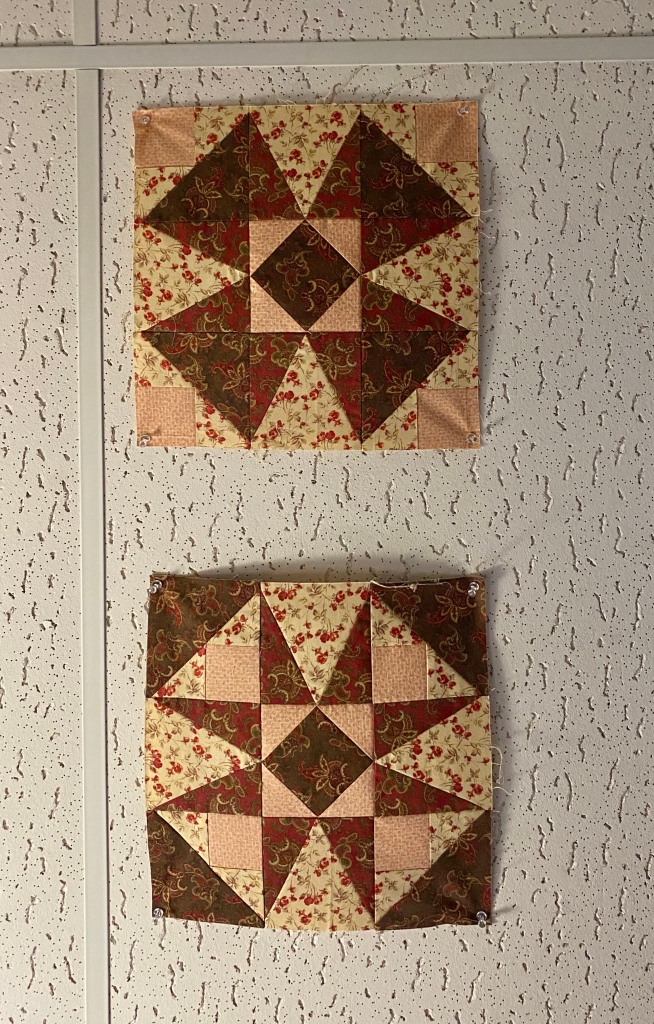
I’m sitting here in Tuckerville, watching TV, looking at my ceiling. I pin orphan blocks on my drop ceiling.
Two of a Kind
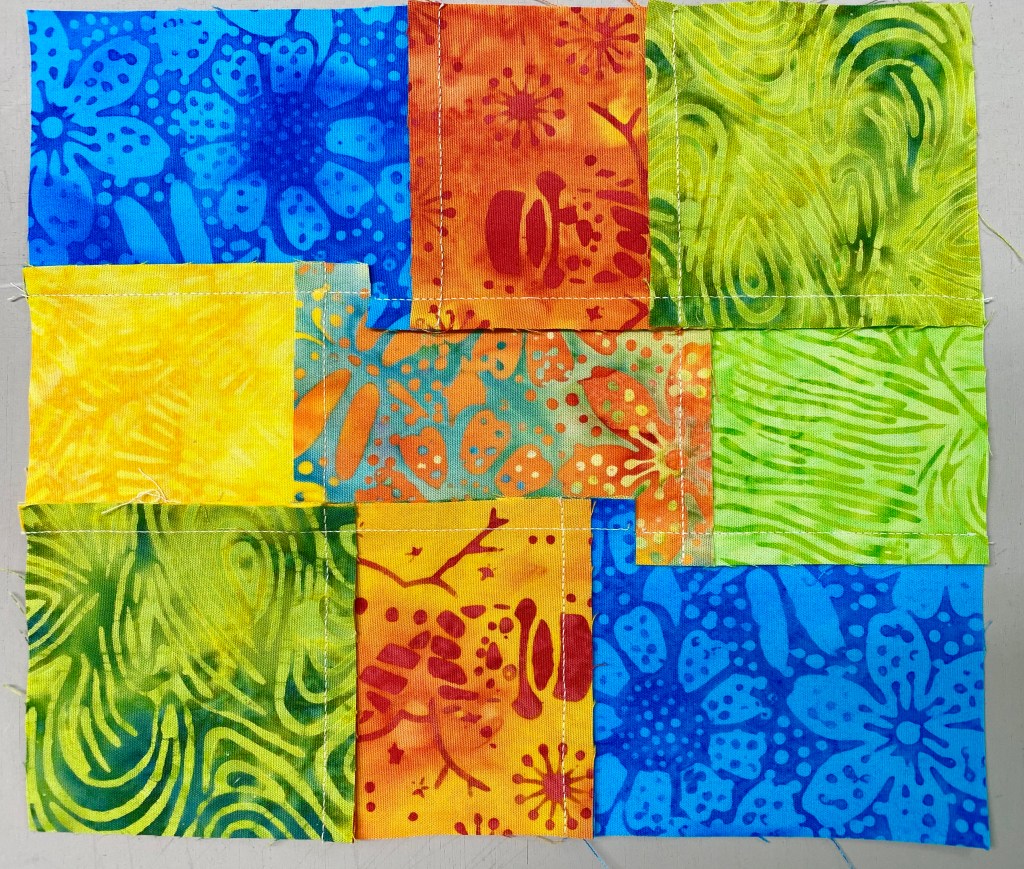
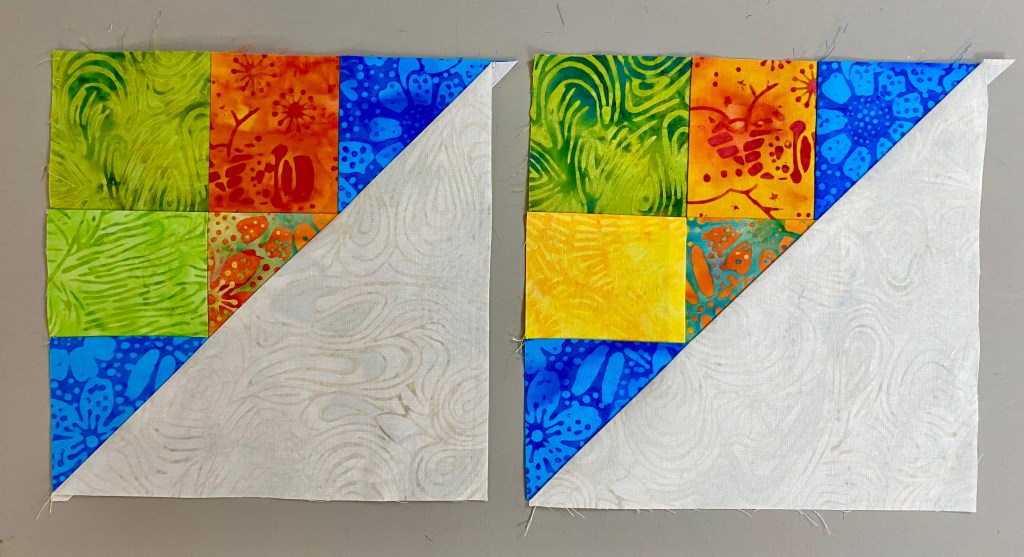
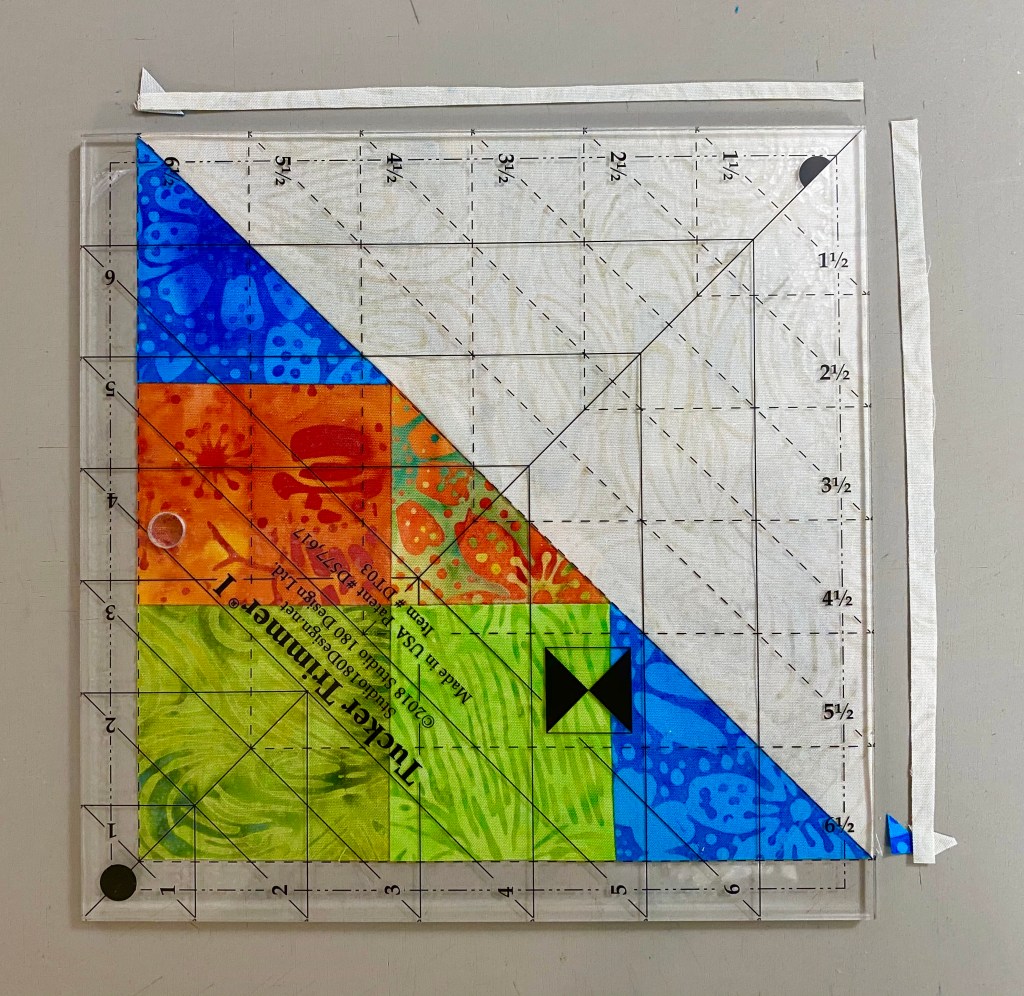
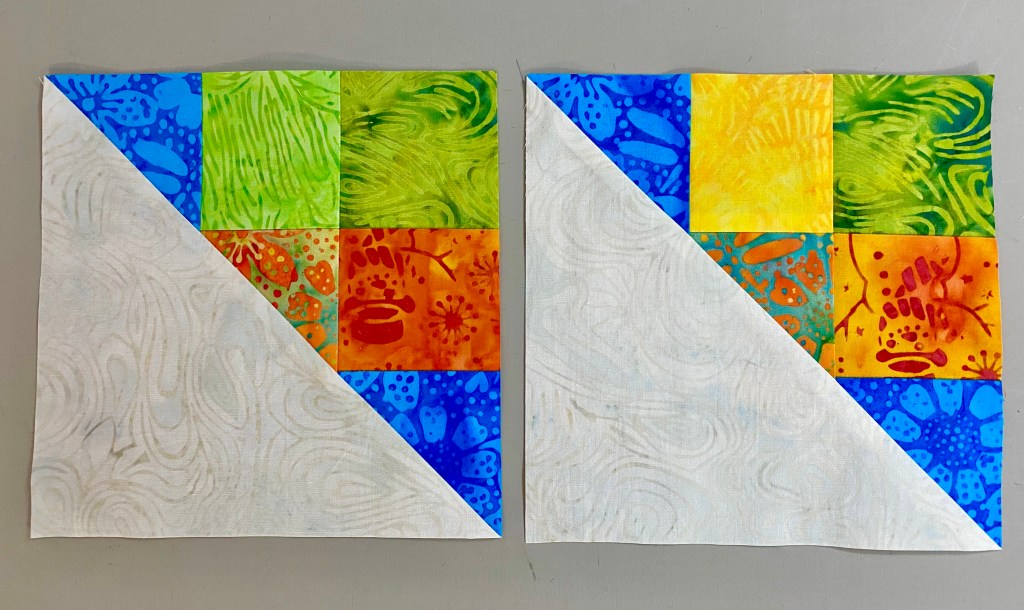
These two blocks are made from the same fabric and units. They both have a Square Squared for the block center, 4 V Block units for the star points and 4 Shaded Four Patch Units (with the Tucker Trimmer I) in the block corners. The top block has the Shaded Four Patch unit small square facing out, while the bottom block has the Shaded Four Patch unit small square facing in. Two very different looks from the same block.
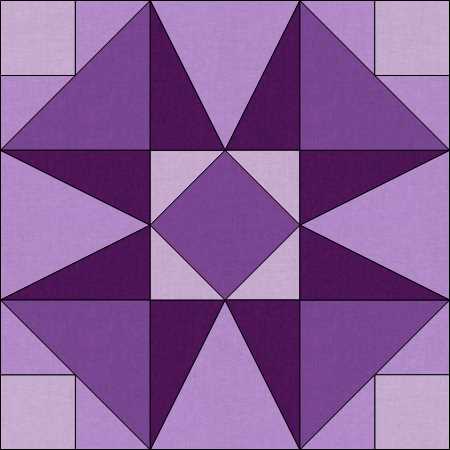
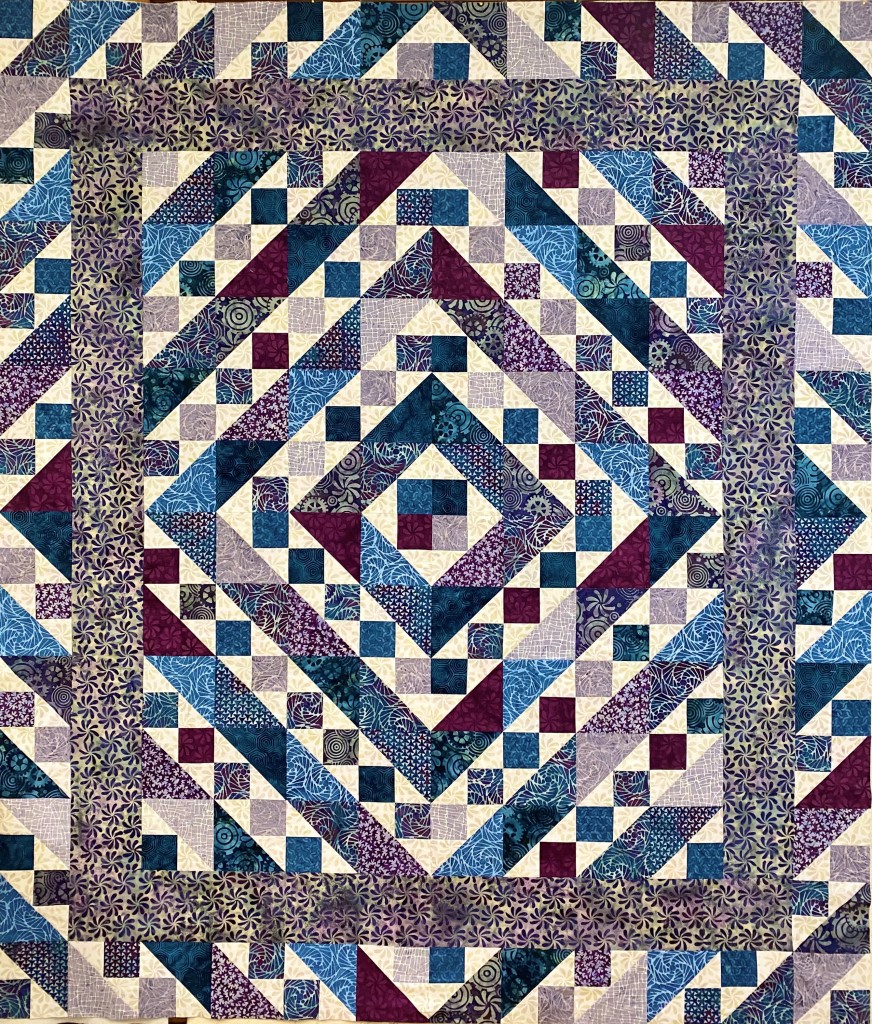
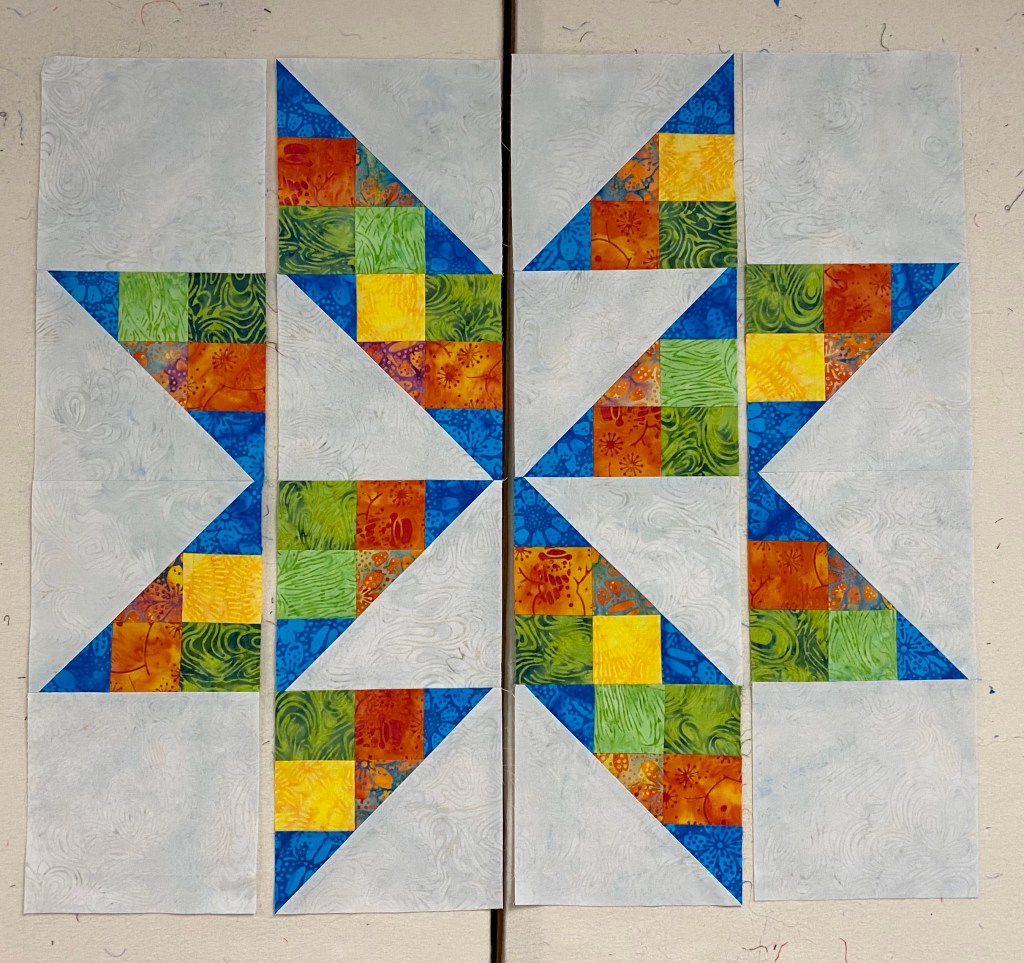
As I stared at these blocks on the ceiling I wondered what the secondary design would be if I put them in a quilt. Time to break out EQ8!
I used shades of purple and lavender because I thought my sister may like it. This is pretty cool. EQ8 is fun to use and brings quilt designs to life. Time to break out my Studio 180 Design tools get busy!
As quilter’s, we all have an angle. Deb Tucker has a new angle and it is 60 degrees! Studio 180 Design will soon be releasing a new Star 60 tool.
Hextravaganza, free pattern included in the Star 60 tool instructions
You all know that I have made many, many One Block Wonders (75). One Block Wonder’s are made by constructing equilateral triangles. An equilateral triangle is created by cutting fabric strips at a 60 degree angle.
Memories of China, by Luana Rubin for Robert Kauffman
I just finished making “Up Up & Away” OBW yesterday and wanted to play with the Star 60 tool. I’ve had this fabric for at least 14 years. It has a medium size design and a 12″ repeat. I HAD to make a kaleidoscope Star 60 Block. I cut my 6 repeats, aligned them and chose to make 5″ finished units. Following the tool instructions, I cut my strips sets 3 1/4″ wide.
First Cut
This strip set has 6 fabric layers. I put a new blade in rotary cutter and it cut through all 6 layers like butter!
Second Cut
Using the Star 60 tool, I cut the first entire 60 degree diamond. Continue cutting till the end of the strip. I got 10 blocks out of one WOF strip.
OBW 60 Degree Cut
Above, I said “I cut the entire 60 degree diamond”, when cutting for a OBW, we cut triangles. By the way you can use the Star 60 tool to cut equilateral triangles for OBW’s. Just be sure that the tool point is on the edge of the fabric strip. We love dog ears for aligning.
On the left is a block from equilateral triangles. On the right are 60 degree diamonds. Both were cut from 6 repeats of aligned fabric.
For the diamonds we need to add side triangles.
As with a OBW, I did not stitch the center seams. Anyone who has taken a OBW class from me knows I think “Y” seam are of the Devil”! “Y” seams are not required to make these blocks.
Measures 36″ x 36.5″
This was fun. I Love the Star 60 tool. The instructions are wonderful, clear and complete. You will have no trouble creating beautiful & unique 60 degree blocks!
Just look at some of the possibilities! If you are not getting the Deb Tucker Studio 180 Design Newsletter sign up www.studio180design.net so you never miss new pattern or tool releases.
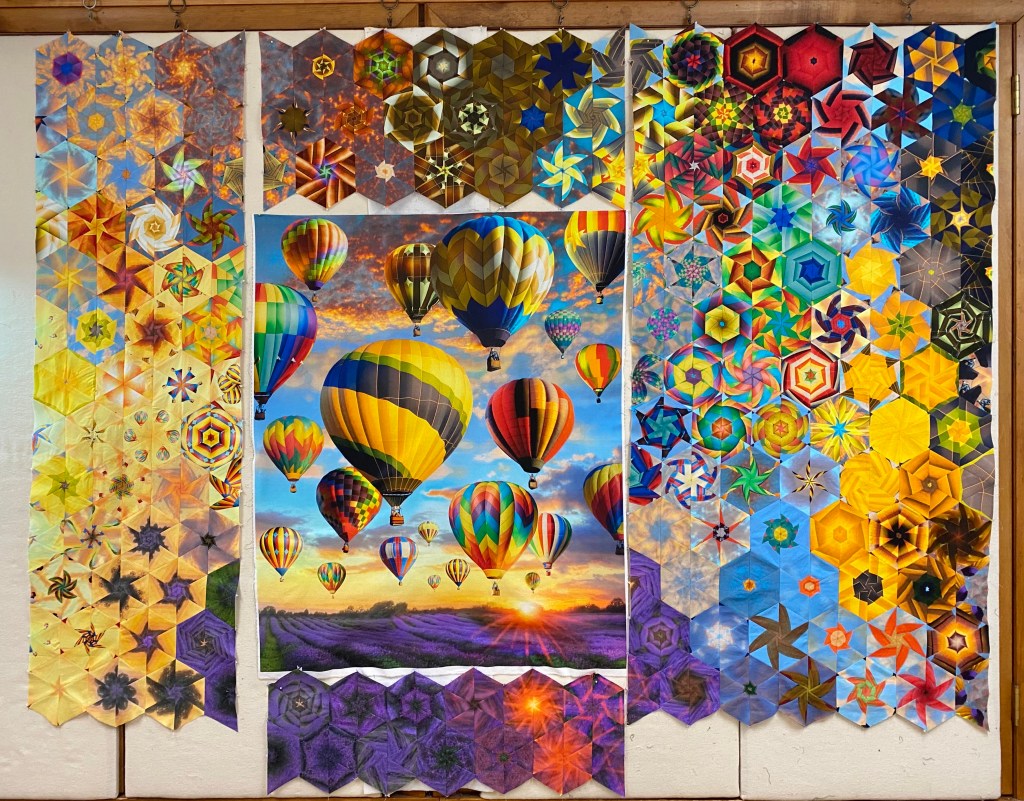
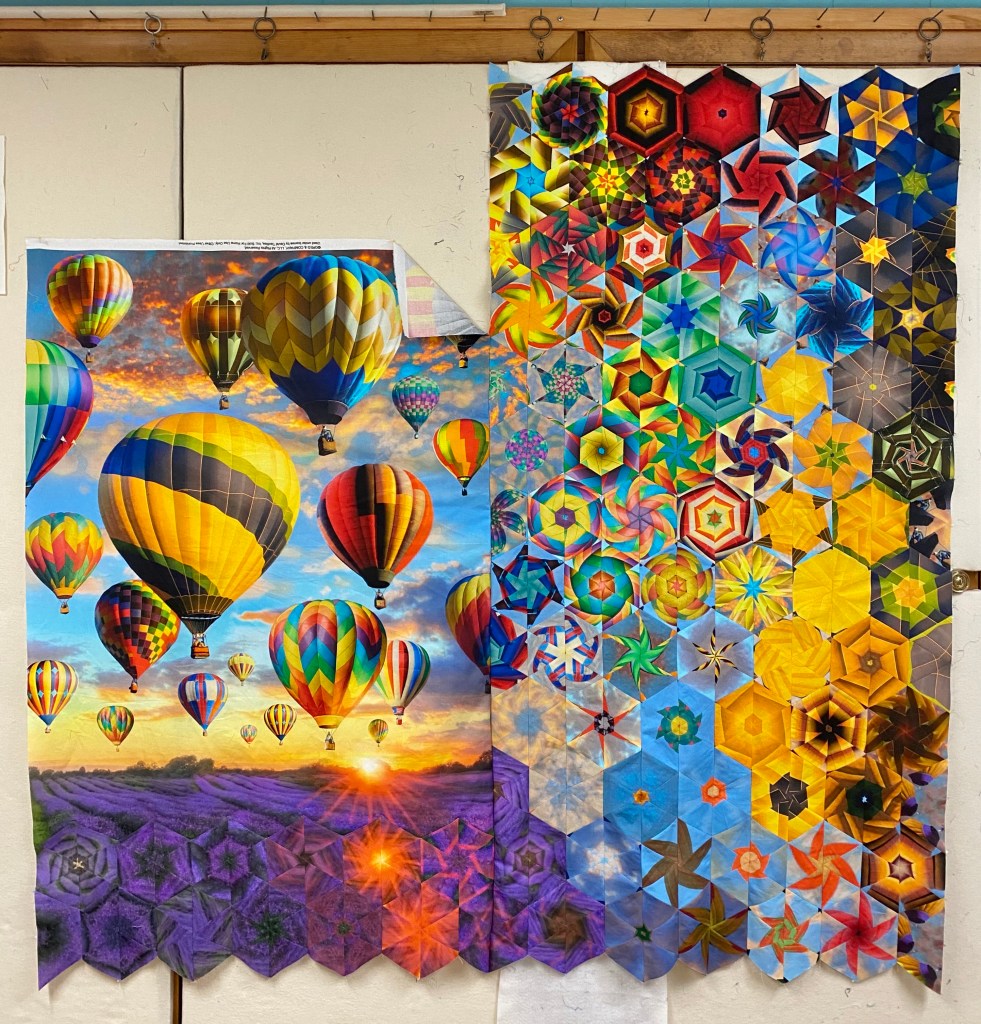
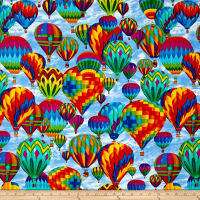
Quarantine quilt number 4 – “Up Up & Away, in My Beautiful Balloon”. While I was visiting my family in Lake Havasu City last January I got to attend their Hot Air Balloon Festival. It was fabulous.
I saw this panel by Greg & Company on eQuilter and just had to get it for a One Block Wonder.
First thing, decide what size strips to cut. I start by trying to get an idea of how many hexies will fit across the top and/or bottom of the panel. It is just like making a pieced inner border to fit around the center of a quilt. The width of the panel should be evenly divisible by the finished size of my hexagon block. This panel measured 34″ x 44″. Even though it is a large print that would support a 6″ finished hexie, the 34″ width is not evenly divisible by 6″. I did not want to trim too much off the panel so I decided to cut my strips 3 1/2″ wide. That would yield 5 1/2″ finished hexagons. If I trim one inch off the panel side making it 33″ x 44″, meaning 33″ divided by 5.5″ = 6. Now I know I will get 6 hexagons (or 12 half hexies) across the width of the panel both top and bottom. Download my Tips for Using Panels for a OBW:
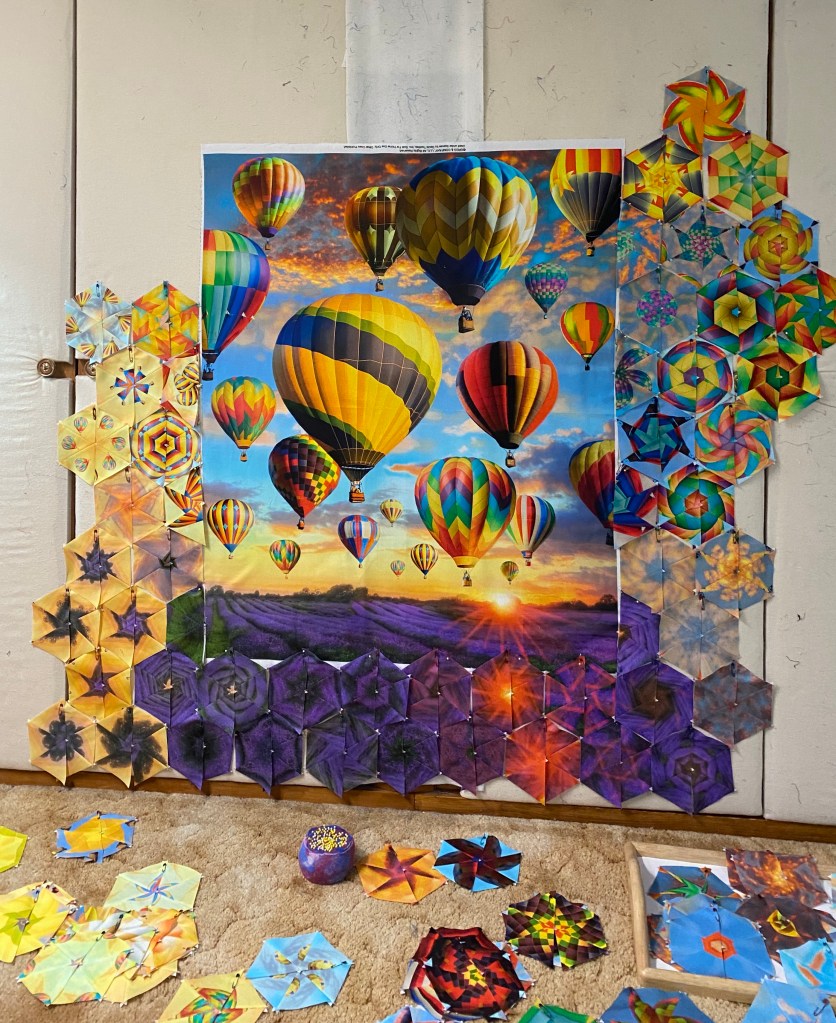
I started at the bottom and worked my way up the sides and across the top.
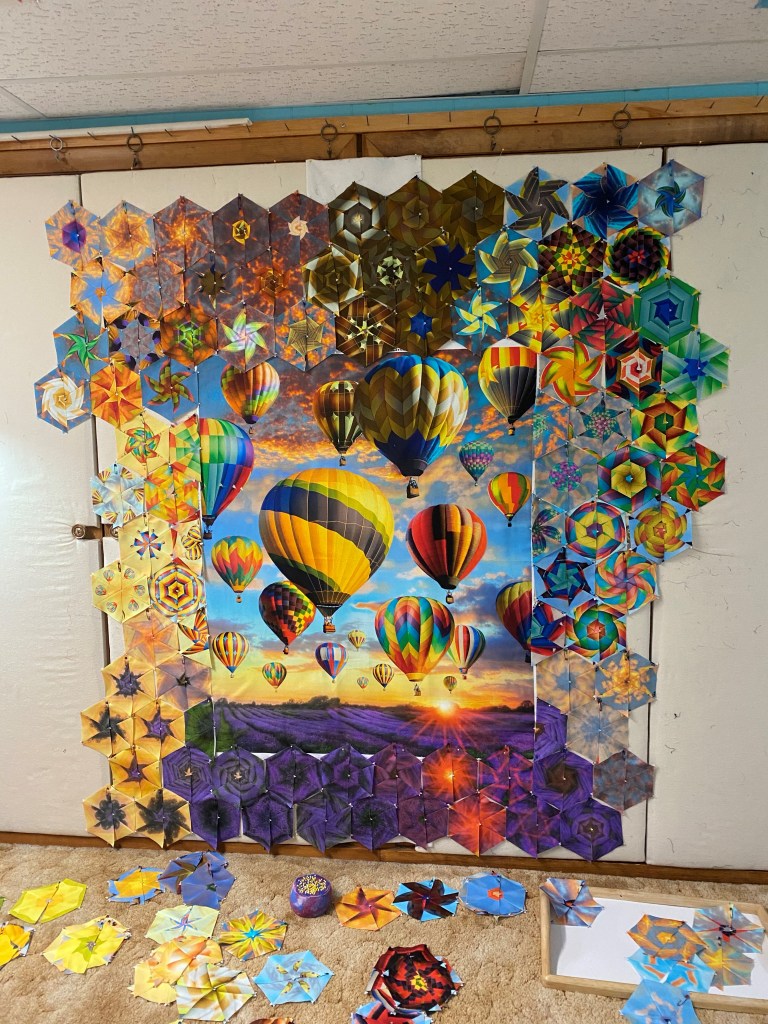
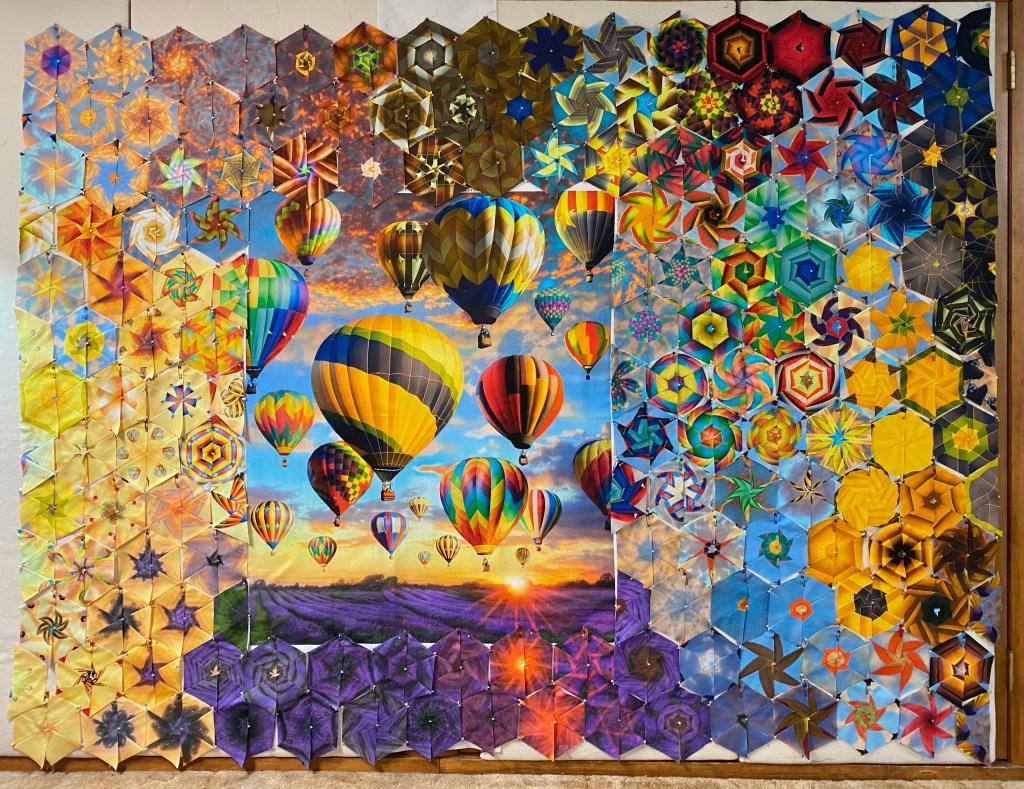
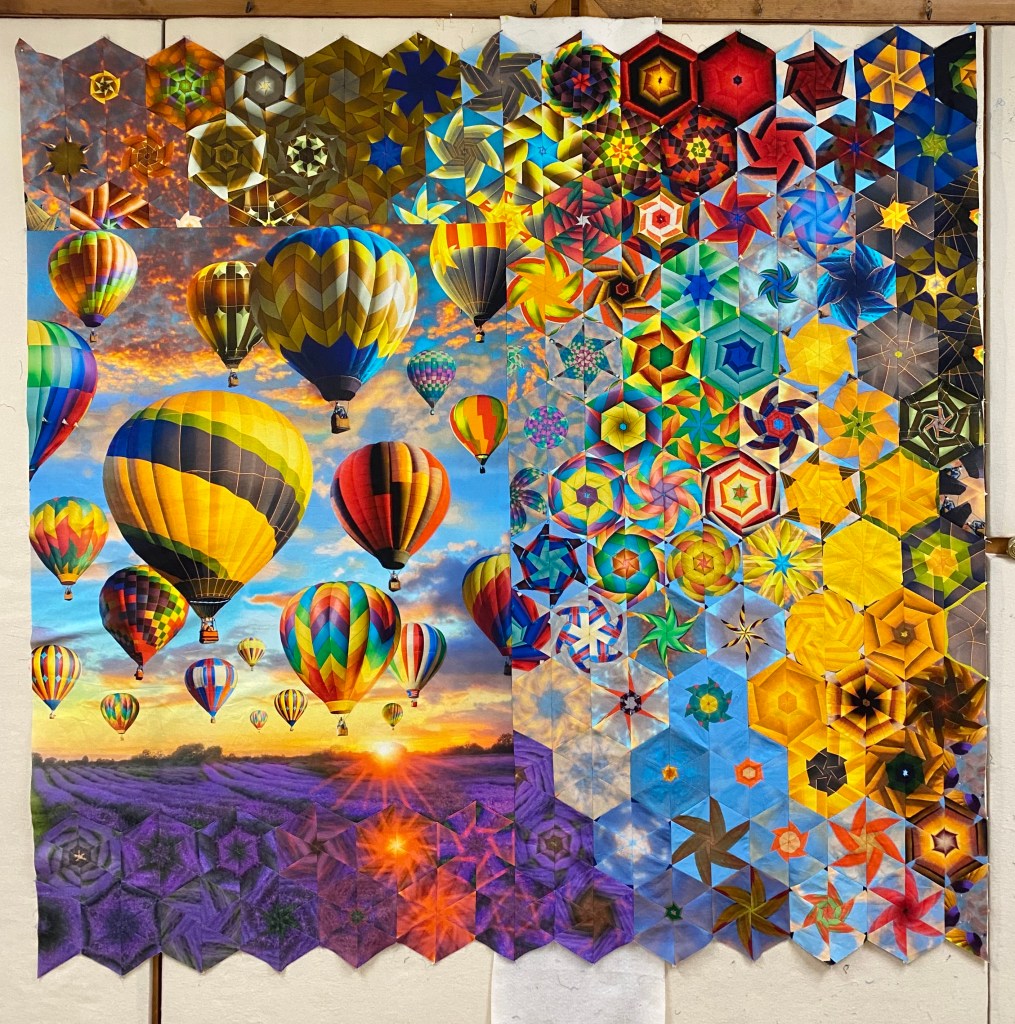
I used most of my hexagons and got achieved a design I was pleased with.
I number my rows and stitch the half hexies into rows. Then I join the rows pressing all seams open. I cannot stress enough how much easier it is to press your seams open with the help of my Strip Stick. I have 4 different sizes. The 48″ Strip Stick makes pressing the long seams open go quickly without disturbing the previously pressed seams.
I stitch my hexies into 4 groups. Top, bottom, left and right.
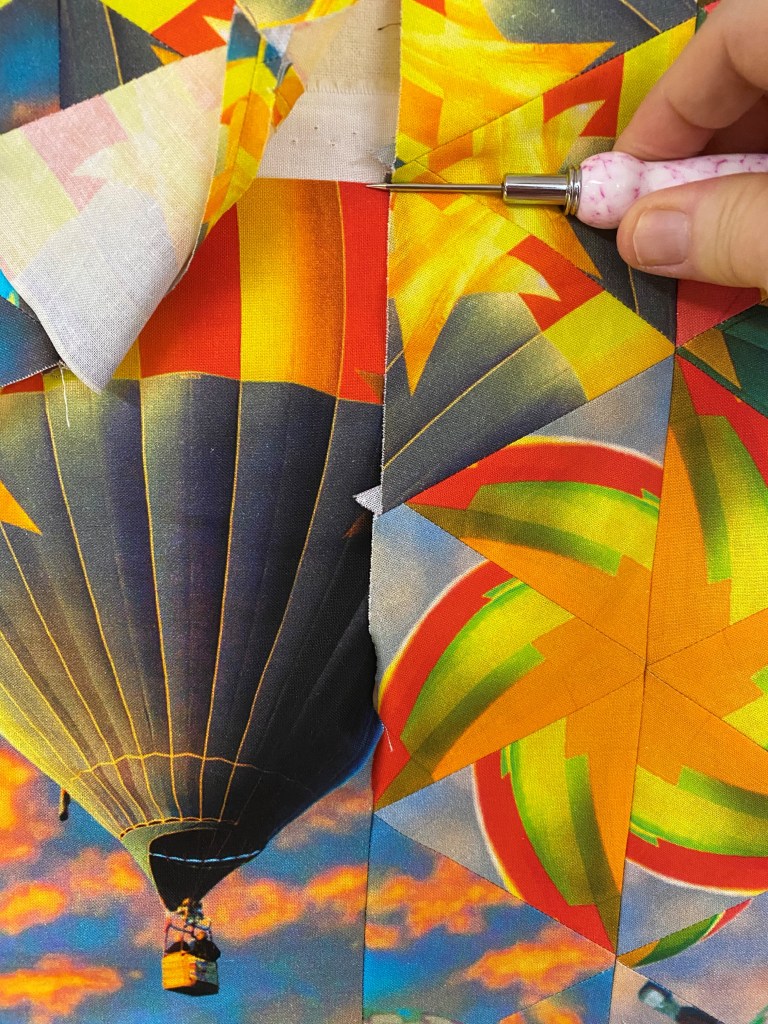
I decided I wanted to applique the bottom section to the panel first. Instead of trimming the points I pressed under a 1/4″ seam and stitched it onto the bottom of the panel. I chose to attach the right side next by matching up the dog ears as you would when joining the rows and stitch three quarters of the way up towards the top of the panel (partial seam).
By using a partial seam, it allows you to match up the dog ears of the top hexies with the side rows of hexies.
I will mark where the top hexies hits the top of the panel, add a 1/4″ seam allowance, trim the hexies and stitch to the top of the panel. I decided to trim the hexies because I did not want to cover the balloons.
Now I can finish the partial seam.
With the top, bottom and side hexies stitched in place, I can easily attach the left side hexies to the panel matching up the dog ears.
This is one colorful One Block Wonder. I have ordered some great fabric from Fabric.Com for the back.
As soon as it arrives I will quilt it and send it you Angie!
Got some fat quarters? Deb Tucker has many free patterns for you and this one is called Twilight Paths. It uses 14 fat quarters and a background with the Tucker Trimmer I. Twilight paths uses 5″ finished Shaded Four Patch units (5.5″ unfinished). The Shaded Four Patch Technique Sheet shows you haw to make this unit in 21 sizes! This whole quilt is made with Shaded Four Patches!
This is Twilight Paths using Deb Tucker’s Twilight Chic fabric line from Island Batik!
Download your pattern and let’s go!
Group 1
Group 2
To get a great scrappy quilt, Deb suggests that you split your fat quarters into two groups. Group 1 along the 22″ side, cut two 3 1/4″ strips and one 6″ strip, sub-cutting into 3 – 6″ x 7″ rectangles. Group 2 along the 22″ side, cut one 3 1/4″ strip and two 6″ strips, sub-cutting each into 3 – 6″ x 7″ rectangles. Cut one more 3 1/3″ strip from leftover from Group 1.
From your assorted dark fat quarters you will need 22 – 3 1/4″ strips, and 64 – 6″ x 7″ rectangles. From your background you will need 22 – 4 1/4″ strips.
Step 1 – Position each 3 1/4″ strip right sides together with a 4 1/4″ wide background strip and stitch lengthwise. Press seams toward the wider strip.
Step 2 – Pair two of the pieced strips right sides together with the narrow strips on opposite sides, so that each narrow strip faces a wide background strip. Sub-cut the strip sets every 3 1/4″ units until you have 128 rectangles.
128 – 3 1/4″ units Pick up each unit the same way when stitching one side.
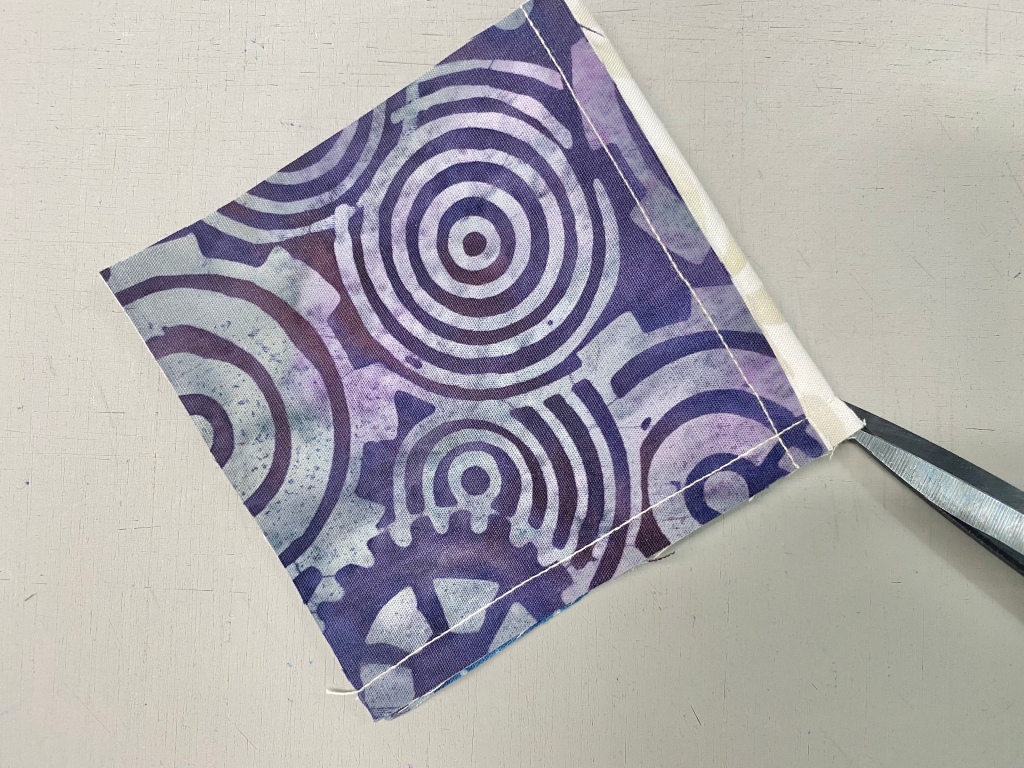
Step 3 – Keep the two rectangles paired; stitch each pair of cut pieces together along one long side. Note the seams are not supposed to nest.
Snip
Snip the seam allowance at the half way mark between the two squares all the way to the seam.
Press each half of the seam allowance away from the square as shown above.
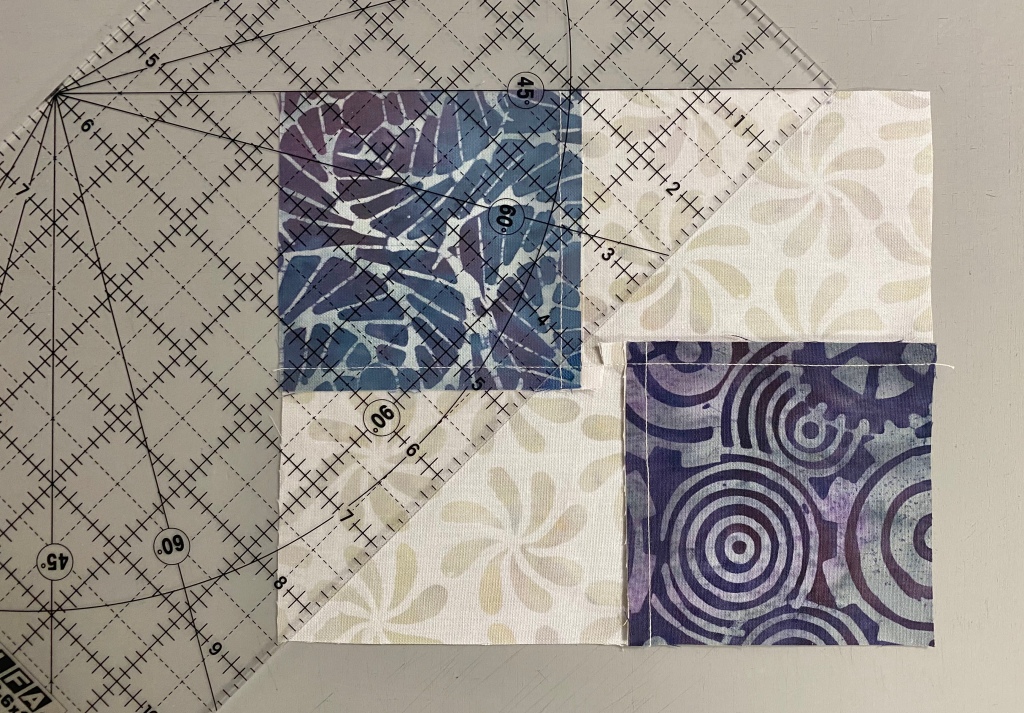
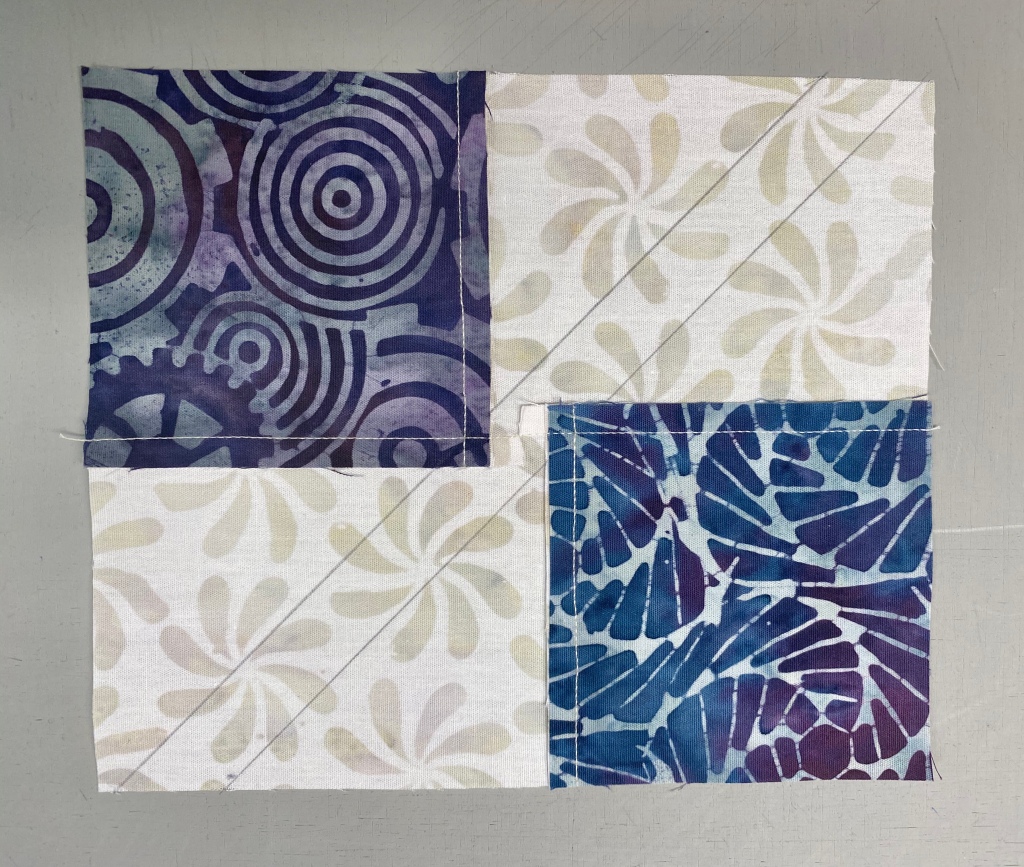
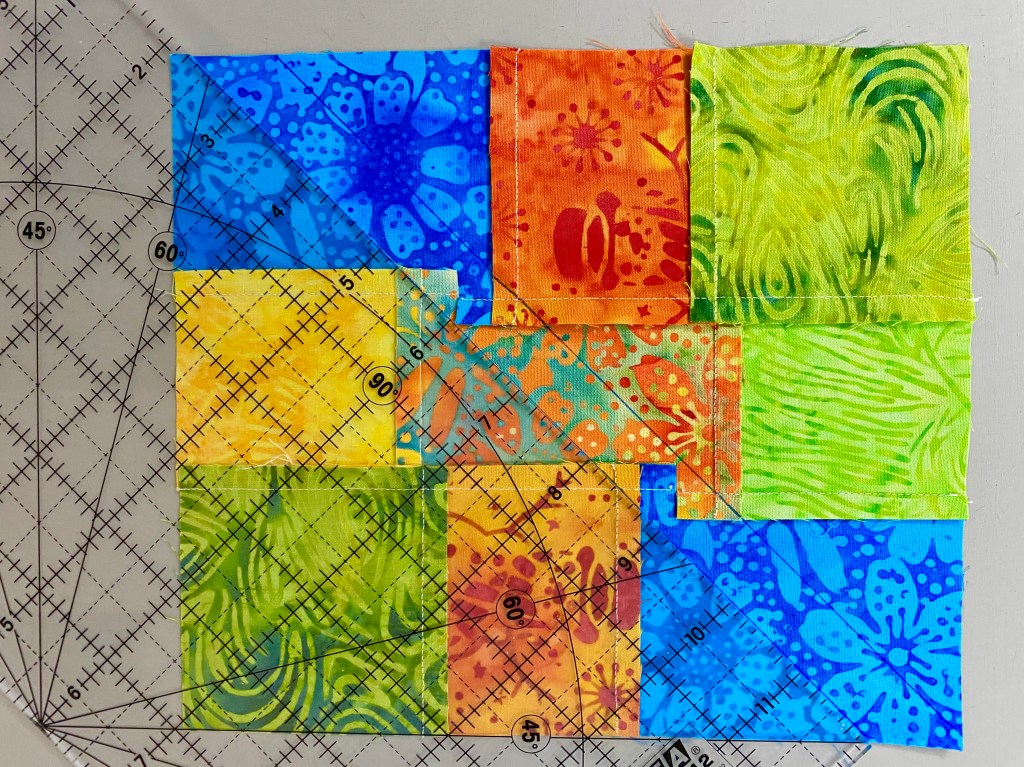
Step 4– Mark stitching lines. Select a ruler with a 45 degree angle marked on it. Draw a 45 degree sewing line from top to bottom, through the corner of the square where the stitching lines meet. Draw a 2nd line through the corner of the other square.
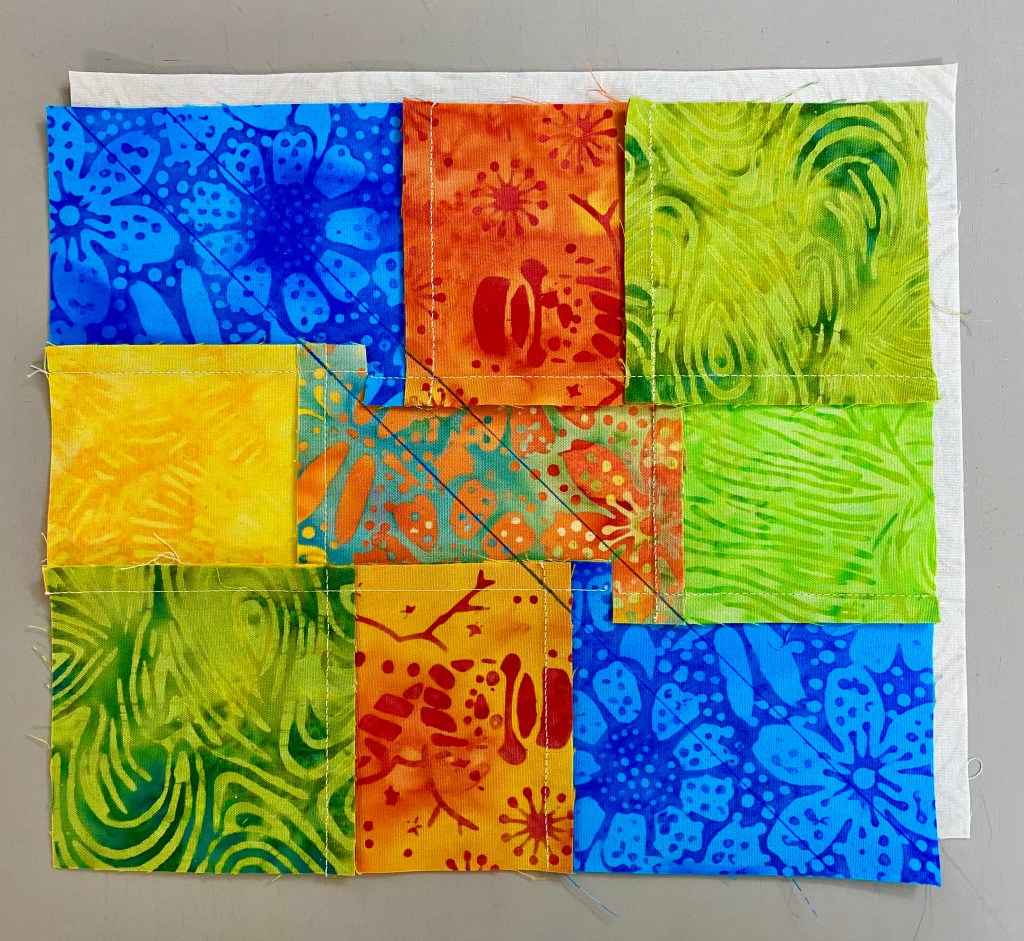
Step 5 – Center each marked, pieced rectangles right sides together with a 6″ x 7″ rectangle.
Stitch on both lines.
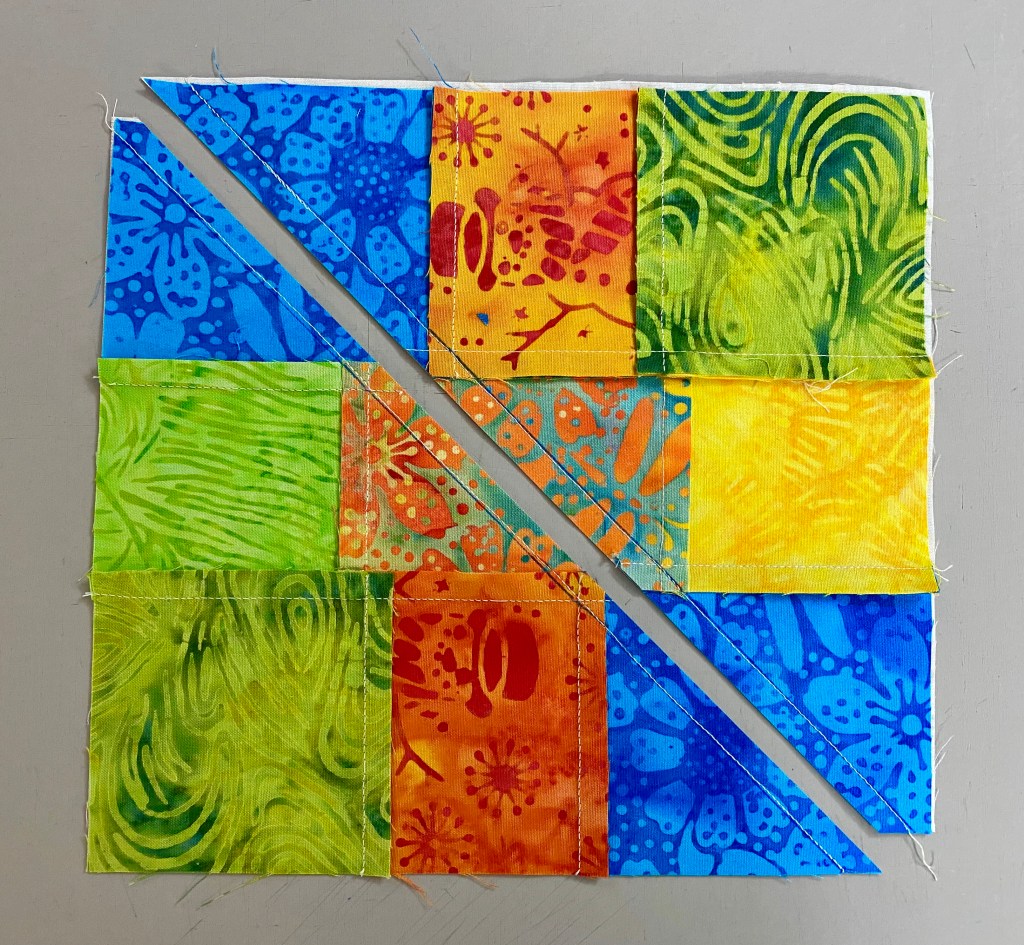
Trim seams 1/4″ from the stitching lines.
Press all seams toward the large triangles.
Step 6 – Trim the 128 oversized units with your Tucker Trimmer I to 5 1.2″ x 5 1/2″. Align the 5 1/2″ Sizing Diagonal with the diagonal seam of the unit. Position the common diagonal so it passes through the center of the unit. Trim the two sides.
Step 7 – Rotate the unit and line up the 5 1/2″ cut size lines on the tool with the previously trimmed edges, align the sizing diagonal and the common diagonal as before and trim the other two edges.
Step 8 – Layout 80 units according to the diagram on page 5 to create the quilt center.
Stitch the units into rows and then stitch the rows together. Press all seams open.
Step 9 – Attach the Inner Border. Stitch the inner border strips to the quilt center.
Step 10 – Assemble the Outer Border. Stitch the remaining units together into 4 border strips containing 12 units each. Make sure you orient the units as shown in the pattern. Press all seams open. Finish as indicated.
My top is not yet quilted. I used Deb Tucker s Steam Engine fabric line by Island Batik in my quilt top. So I guess I will call mine Steam Engine on the Tracks!
I was scheduled to teach the Shaded Nine Patch Star to the Thread Bears Quilter’s Guild of Sherill, NY in May. But as it doesn’t look like I will be able to, so I am going to teach it here.
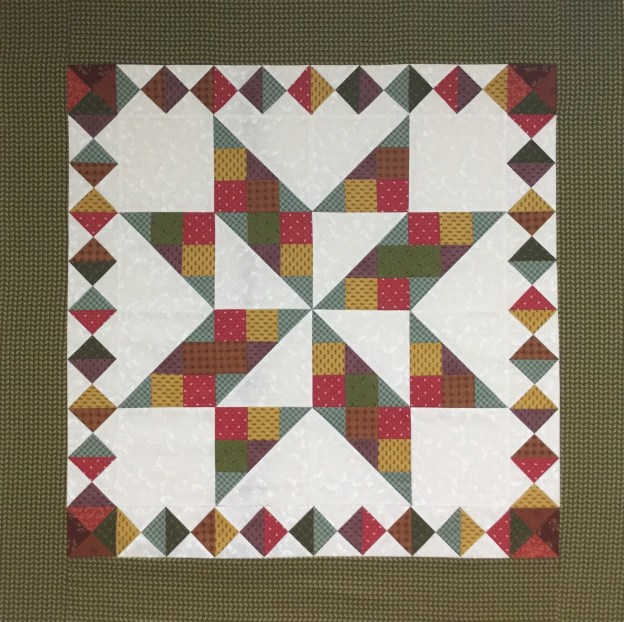
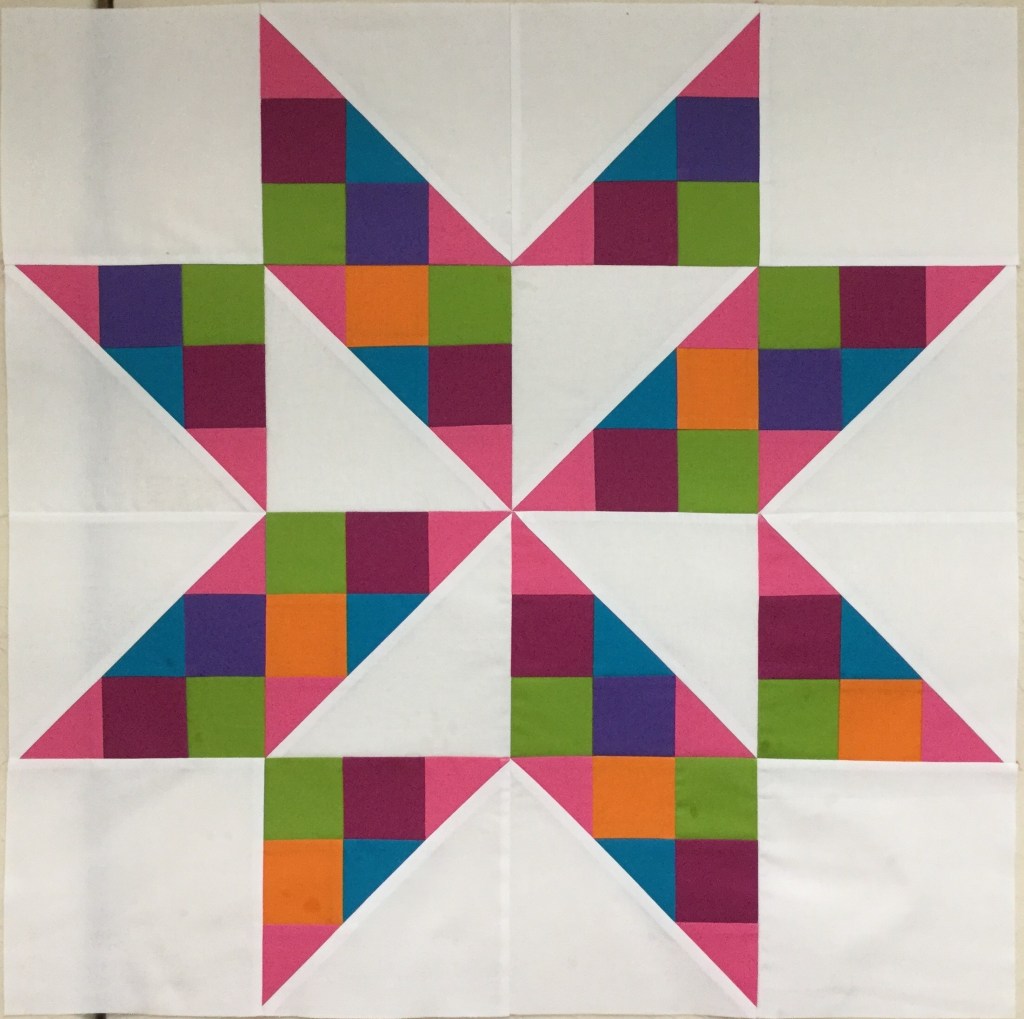
This star was designed by Studio 180 Design Certified Instructor Sarah Furrer. I love it as a fun way to learn the Shaded Nine Patch Unit. The Shaded Nine Patch is an amazing unit that has endless possibilities & can be made in 7 sizes. Maybe Sarah will make it a pattern someday. You will need the Tucker Trimmer I, Magic Wand and Shaded Nine Patch Technique Sheet. Down load the lesson & supply list here:
Choose 6 fabrics and a background. You may choose Width of Fabric Strips (WOF) OR Fat Quarters and cut more strips.
Background: 1 Yard
6 different – ¼ yard fabrics or 6 fat quarters
Border & Binding: 1 yard
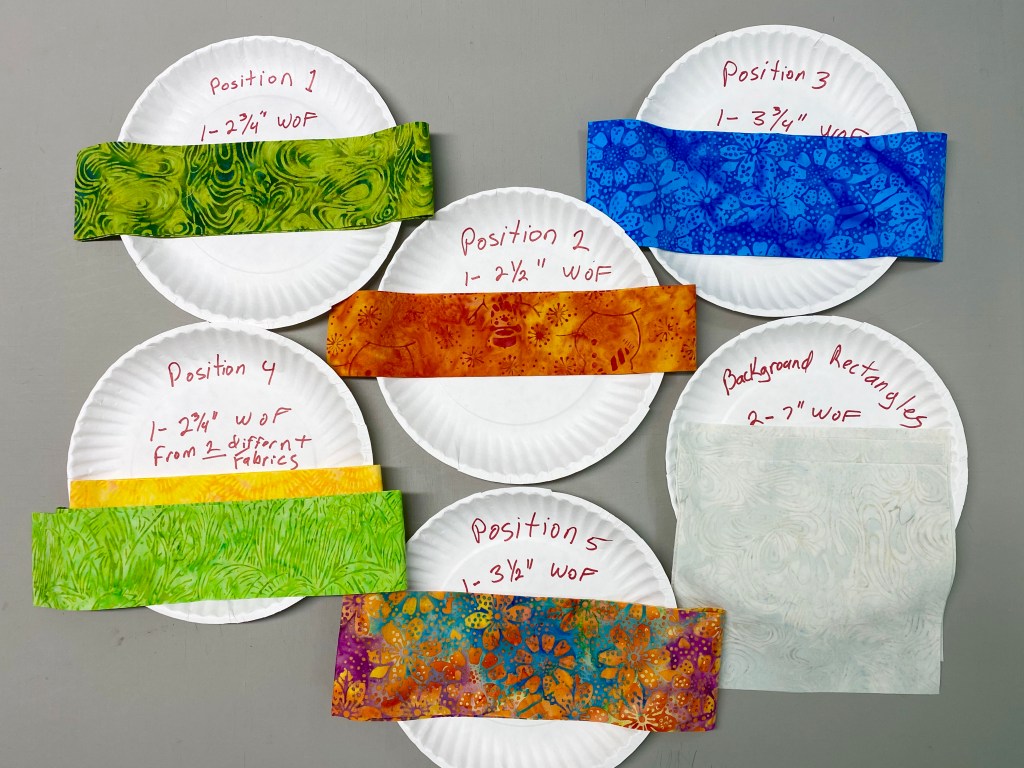
Cutting Strips for the Shaded 9 Patch Block: We will be making 12 – 6″ finished Shaded Nine Patch Units.
Position 1: Cut 1 – 2 3/4″ WOF strip
Position 2: Cut 1 – 2 1/2″ WOF strip
Position 3: Cut 1 – 3 3/4″ WOF strip
Position 4: Cut 1 – 2 3/4″ WOF strip from 2 different fabrics
Position 5: Cut 1 – 3 1/2″ WOF strip
Rectangles (from background fabric): Cut 2 – 7″ WOF strips. Sub-cut into six 7″ x 8″ rectangles
Background Fabric: (Aside from the rectangles above) Cut 4 – 6 ½” squares for the star corners.
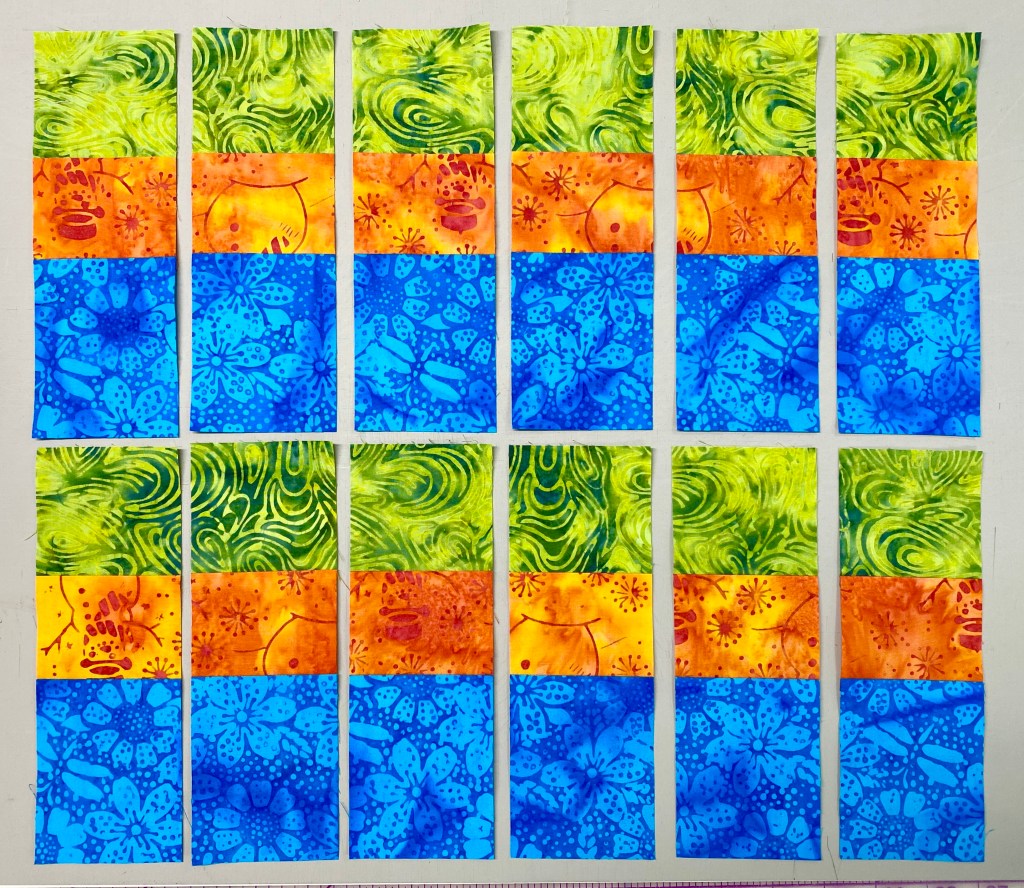
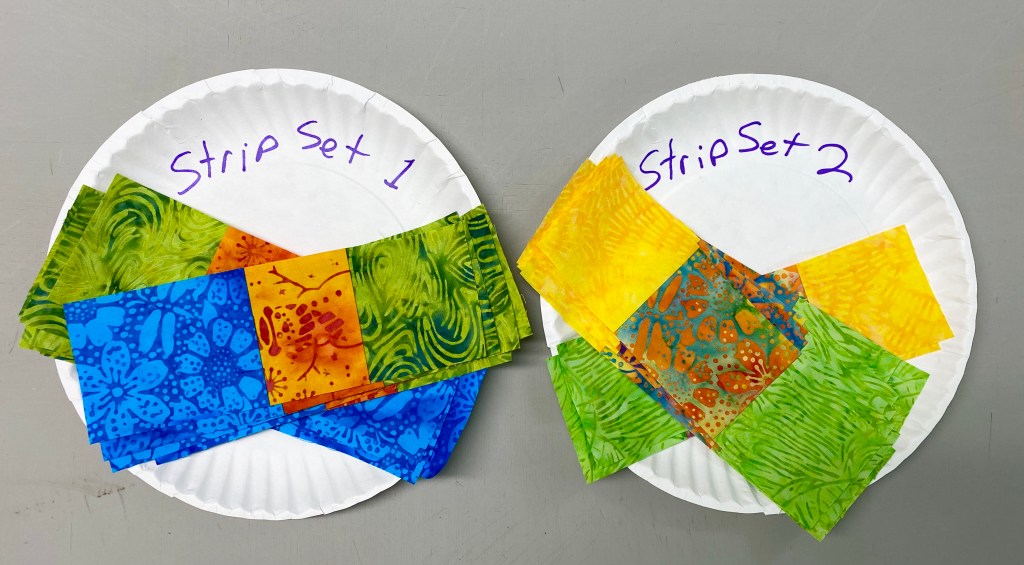
Note: It is a good idea to label paper plates for each Position to keep your strips organized.
Step 1 – Each block requires two strip sets. You will need to make twice as many of the First Strip Set as you will the Second Strip Set.
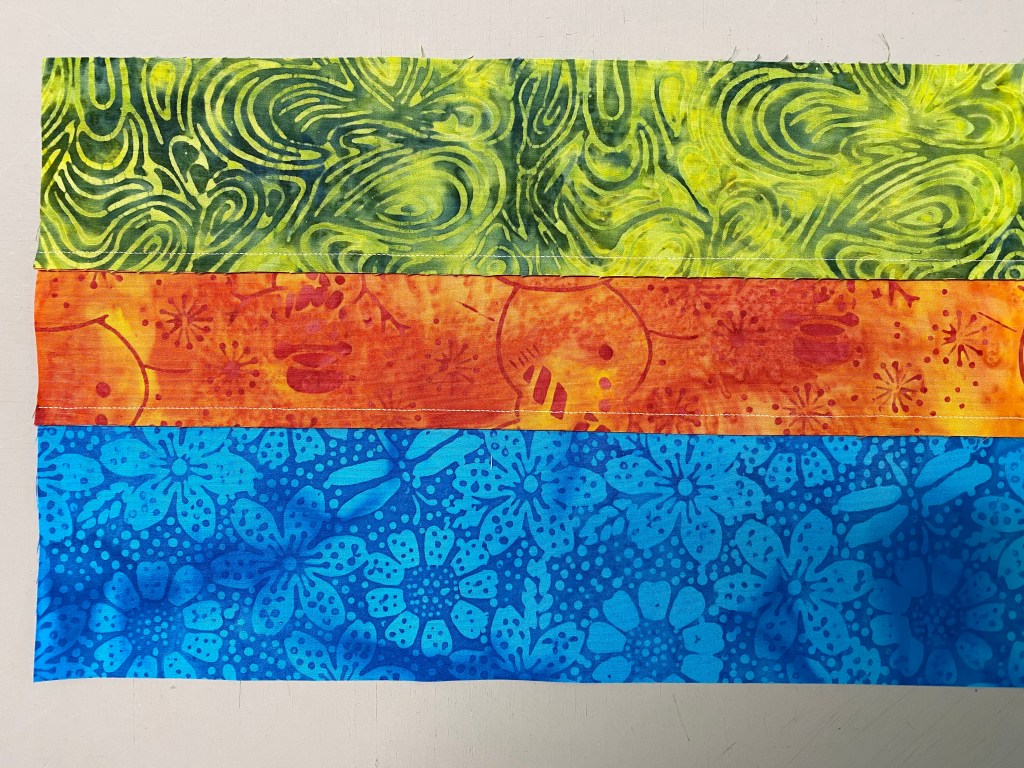
Piecing the First Strip Set – take one strip each of the fabrics for position 1, 2 and 3. Sew them together along the long edge, right sides together in the order shown. Press all seams toward position 3.
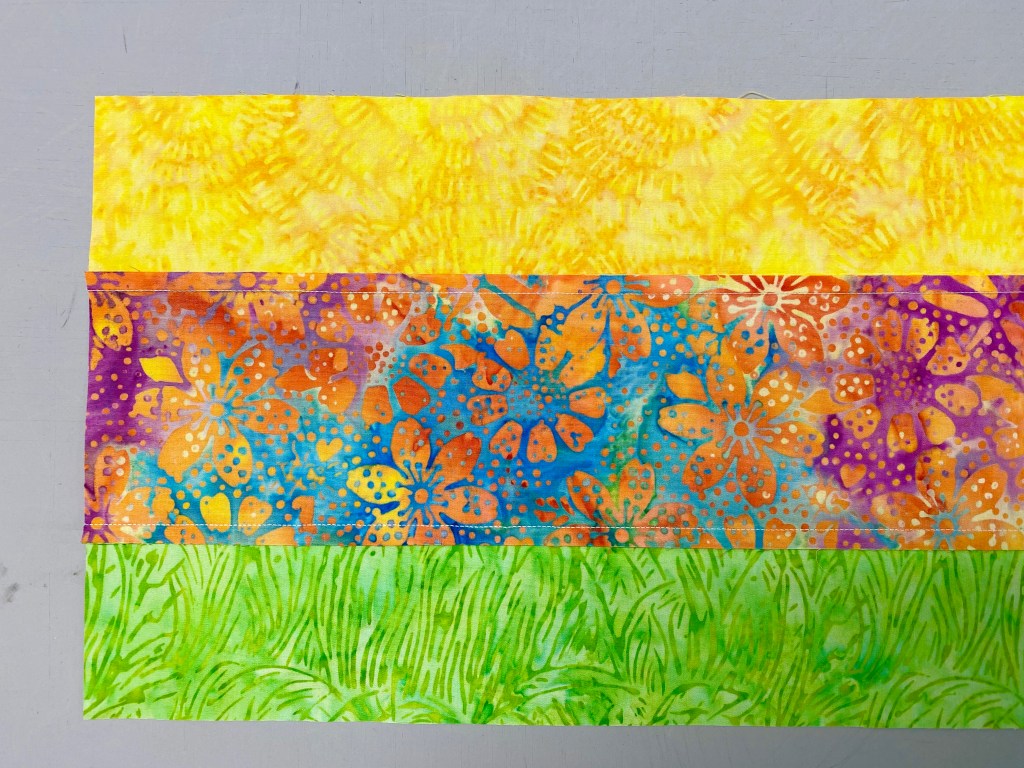
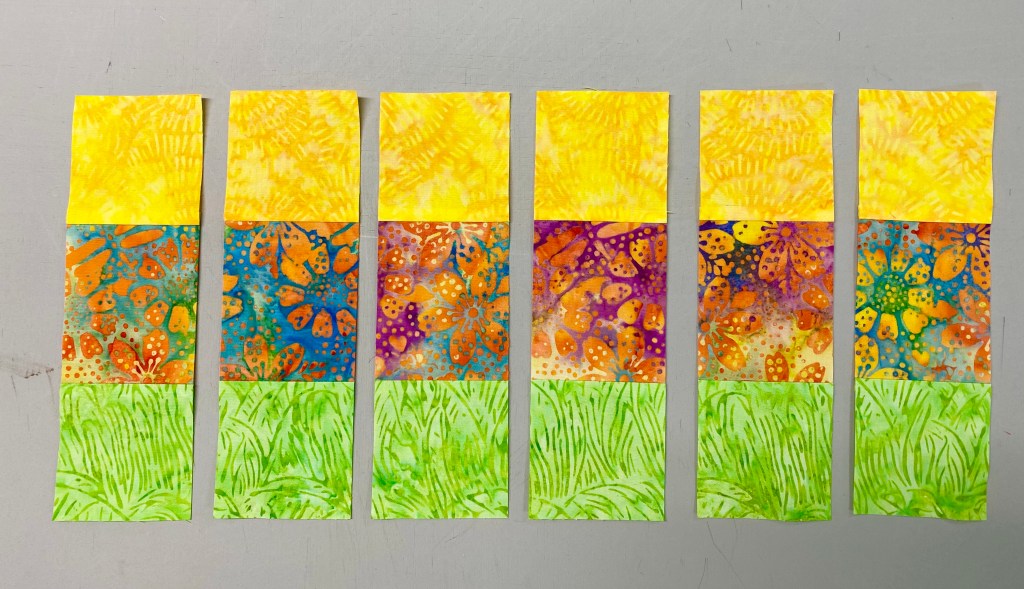
Piecing the Second Strip Set – take one strip for position 5 and two strips of fabric for position 4. Sew them together along one long edge, right sides together in the order shown. Press seam towards the position 4 strips.
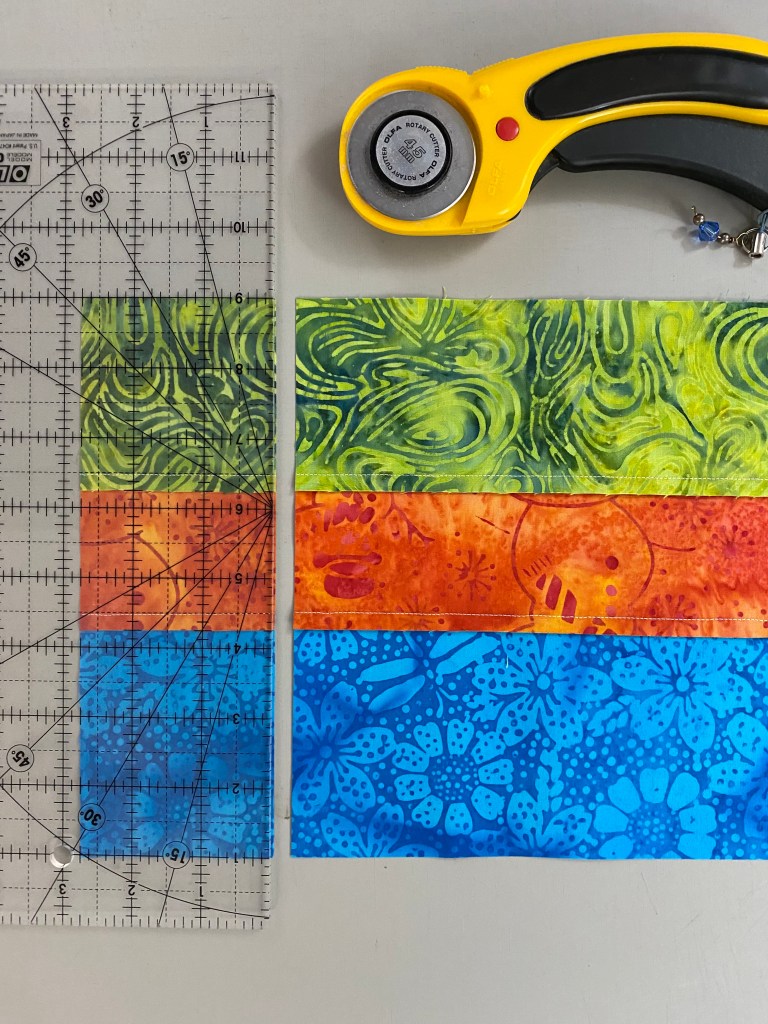
Step 2 – For the First Strip Set only – sub-cut crosswise the width of the strip for Position 1. We are making a 6” finished unit, Position 1 strip is 2 ¾” wide, you will sub cut your sections 2 ¾” wide.
Sub-cut 12 – 2 ¾ wide Strip Set 1” units.
For the Second Strip Set only – sub-cut crosswise the width of the strip for Position 2. We are making a 6” finished unit, Position 2 strip is 2 ½ ” wide, you will sub cut your sections 2 ½ ” wide
Sub-cut 6 – 2 ½” wide Strip Set 2 units.
Tip: To keep organized label plates for Strip Set 1 & Strip Set 2
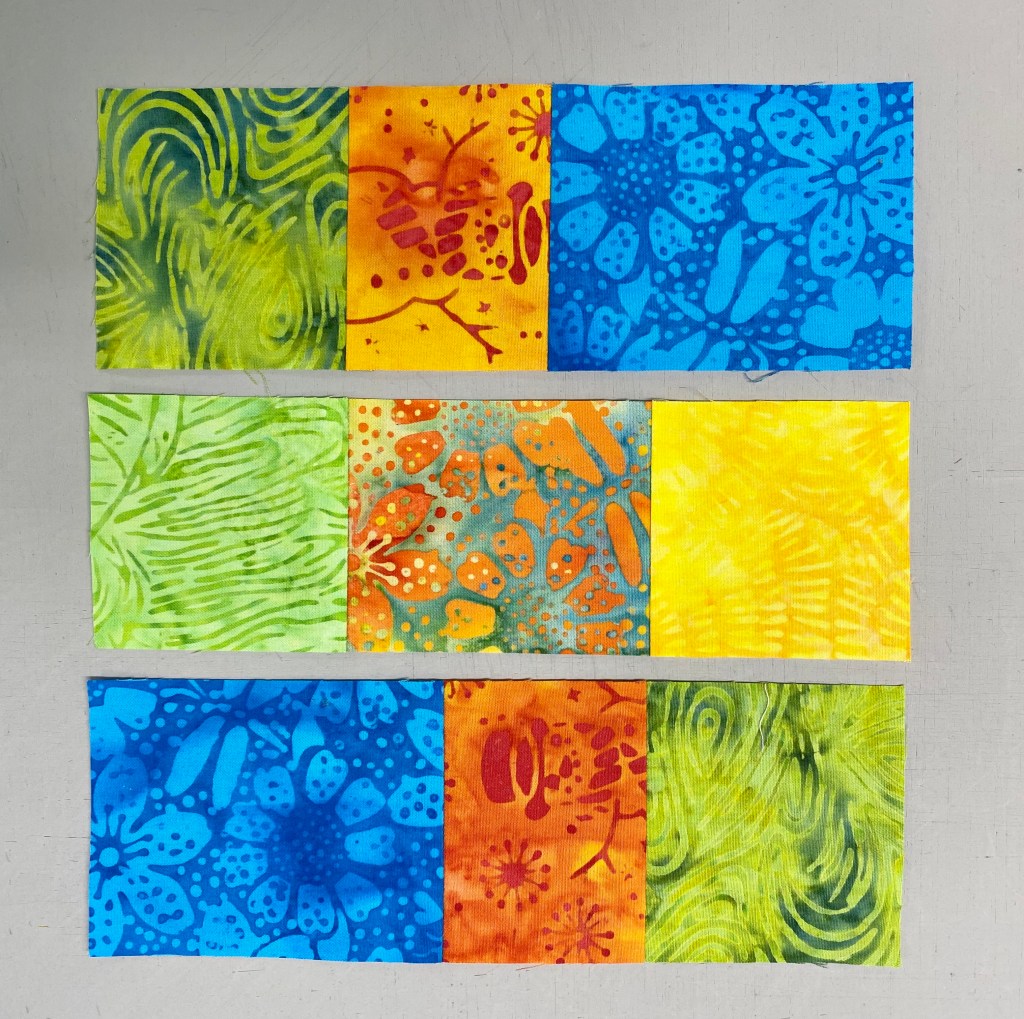
Step 3 – Stitch the strip set units together. Lay them out as shown. Seams will nest between positions 1 & 4. Note: Row 1 is Strip Set 1, Row 2 is Strip Set 2 and Row 3 is Strip Set 1, but reversed.
Before you press, you will need to snip the seam allowance in two places as shown. Press each half of the unit as shown. (See down loadable lesson and/or Shaded Nine Patch Technique Sheet for detailed description.)
Step 4 – Select a ruler with a long 45 degree angle marked on it. The edge of your ruler needs to be at least as long as the diagonal of the unit. Place you’re your sewn rectangle right side down, horizontally on your work surface and draw a 45 degree line from top to bottom, through the corners of the squares labeled 2 and 4 where the stitching lines meet.
Draw a second 45 degree line through the corner of the other position 2 and 4 squares.
Step 5 – Center each marked unit over a large rectangle, right sides together. They may not be exactly the same size.
Step 6 – Stitch on both of the marked sewing lines. Cut apart.
Press toward the large triangle. Remember: “Whatever your are pressing toward, goes on top!”
Step 7 – Position the 6 ½” sizing diagonal of your Tucker Trimmer on the unit so that it lines up with the diagonal seam line of the Shaded Nine Patch. Position the common diagonal so it passes through the center of position 1 square. Trim your first two sides.
Step 8 – Rotate the unit and line up the 6 ½” size lines on the Tucker Trimmer with the trimmed raw edges. Adjust as needed. Trim both sides.
Make five more sets for a total of 12 blocks.
Take your 12 blocks and four 6 ½” background corner squares & layout your star. Stitch into rows, press seam open. Join your rows, press seams open.
Please see the down loadable lesson plan to complete your Shaded Nine Patch Star.
It is late March 2020. Most of us are quarantined inside. At least those of us in New York are! I had planned to schedule a class at Stash away Quilt Shoppe in Rome NY, for a Quilt of Valor using the Rapid Fire Lemoyne Star ruler. I decided to just post the lesson here and share it with anyone who would like to make Patriotic Lemoynes.
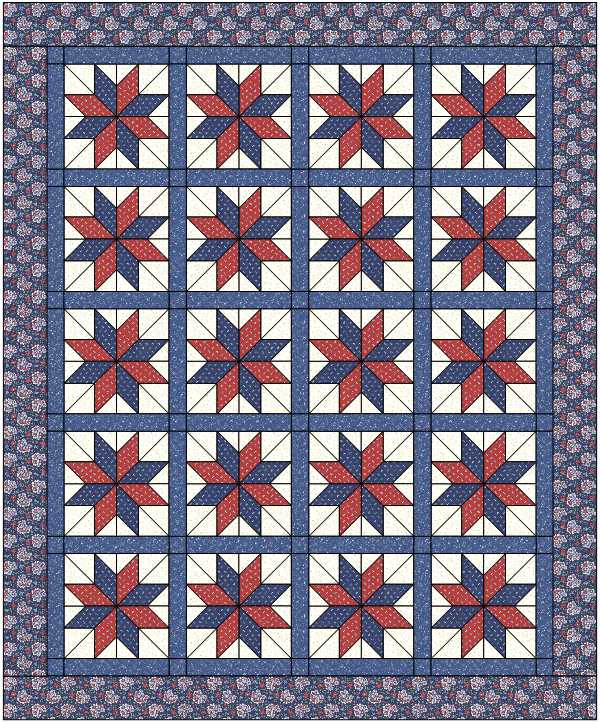
I went to my EQ8 software and designed this quilt for Lynn. This is a great skill builder for those that took the Tucker University Rapid Fire Lemoyne Star class but haven’t made a project yet. This quilt measures 68″ X 82″ with 20 – 12″ finished Lemoyne star blocks. The supply list and instructions are available here for download.
Understanding the “Cutting Chart”. The chart in the tool instructions gives you valuable information for 10 Finished Size Blocks: Cut Size of Star Strips, Cut size of Background Strips, Minimum Strip Length for One Block & Approx. # of Diagonal Cuts from Full WOF strips. For 12” finished blocks, you need a minimum of 24” star & background strips to be able to make one block.
Block Construction: (Width of Fabric – WOF)
Background Fabric: Cut 20 – 4 3/4″ WOF strips
Red Star Points: Cut 10 – 3 1/4″ WOF strips
Blue Star Points: Cut 10 – 3 1/4″ WOF strips
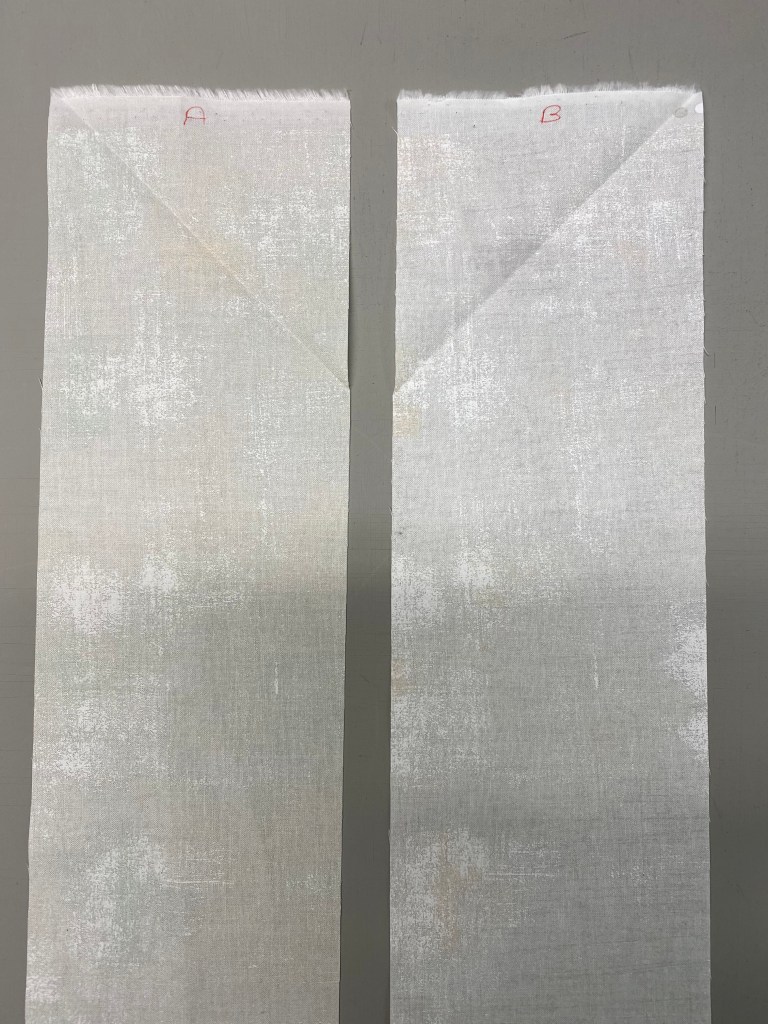
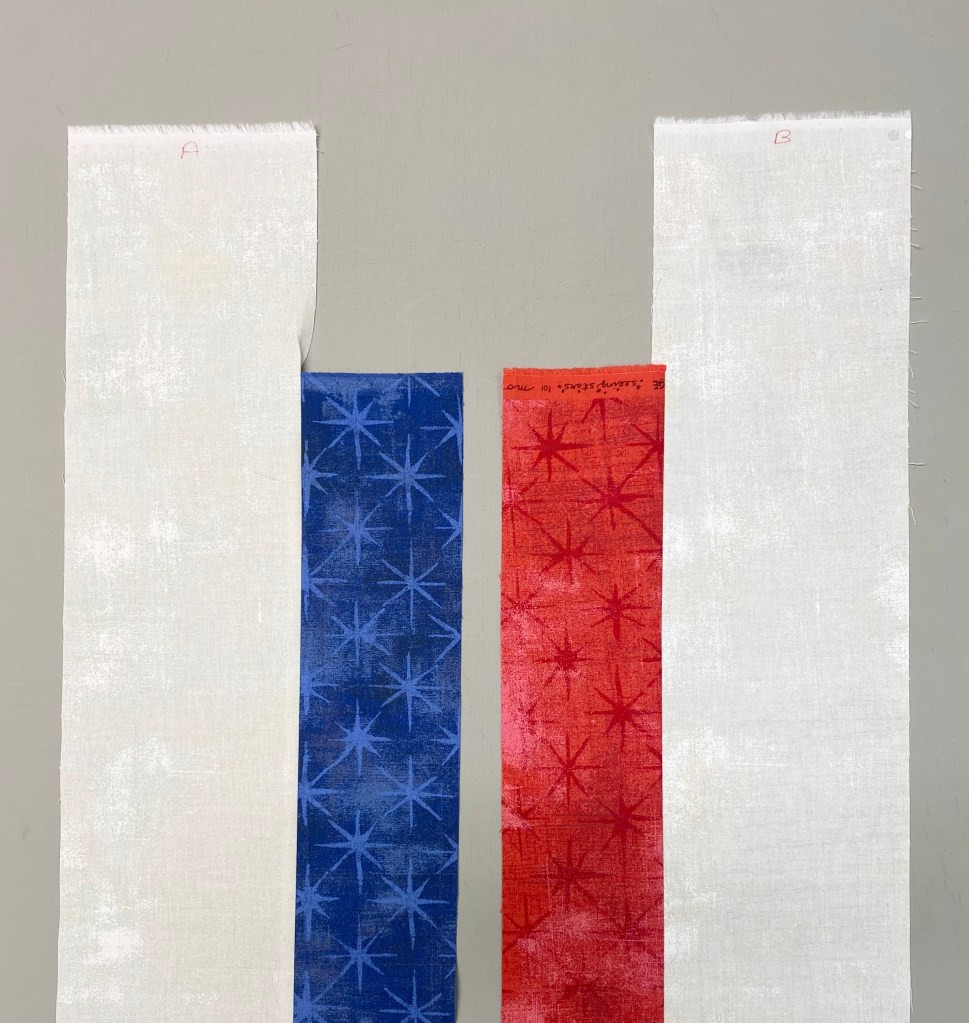
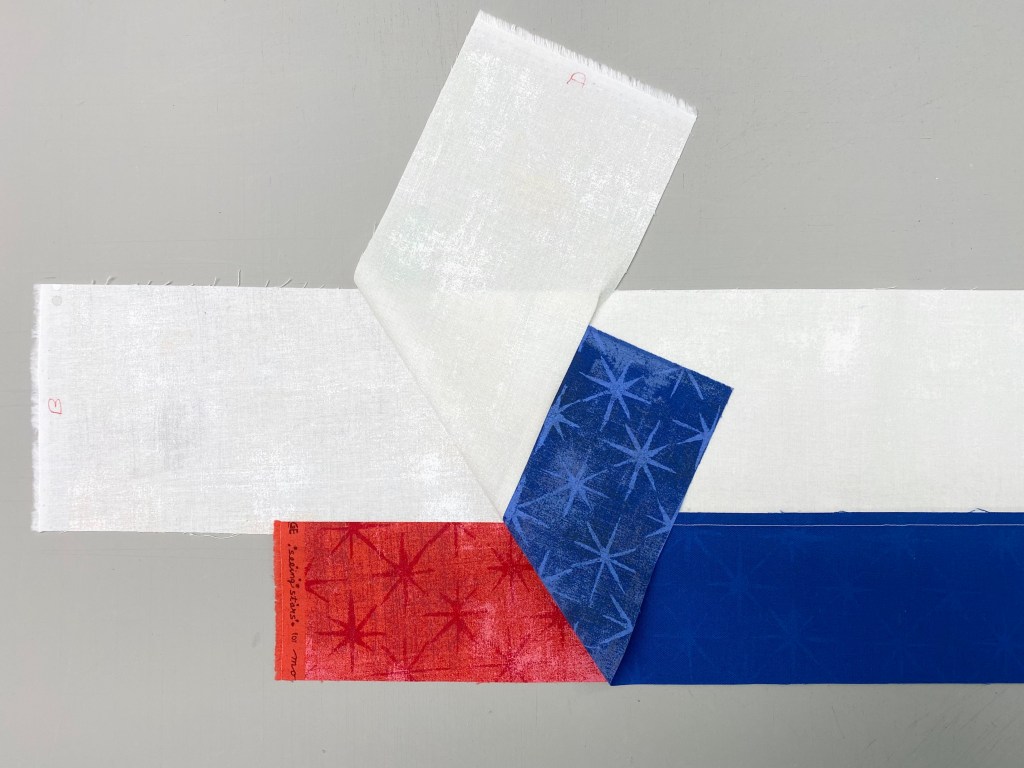
Step 1 – Make 2 piles of 10 background strips right sides up – side by side. At the top, mark 10 “A” & 10 “B”.
Establish the starting point for placement of our star strips by making two additional marks down from the top of the strip, on the inside edges of each strip, the same width as our strip is wide. Our background strips are 4 ¾” wide. OR simply fold top right corner over to the left edge for “A” matching raw edges and top left corner over to the right edge for “B”.
Step 2 – Position a star strip right sides together with each of the background strips starting 4 ¾” down from the top.
Step 3 – Using your Best ¼” Seam, Stitch the “A” strip on the right side & the “B” strip on the left side. (Do not use a scant ¼” seam.)
Step 4 – Press: The “A” strip should be pressed toward the background strip. The “B” strip should be pressed toward the Star Strip. Remember “whatever you are press toward goes on top”!
Step 5 – Position: Move the strips to the cutting mat and layer the strip pairs right sides together, background strip to background strip & and star strip to star strip. The long seams should nest.
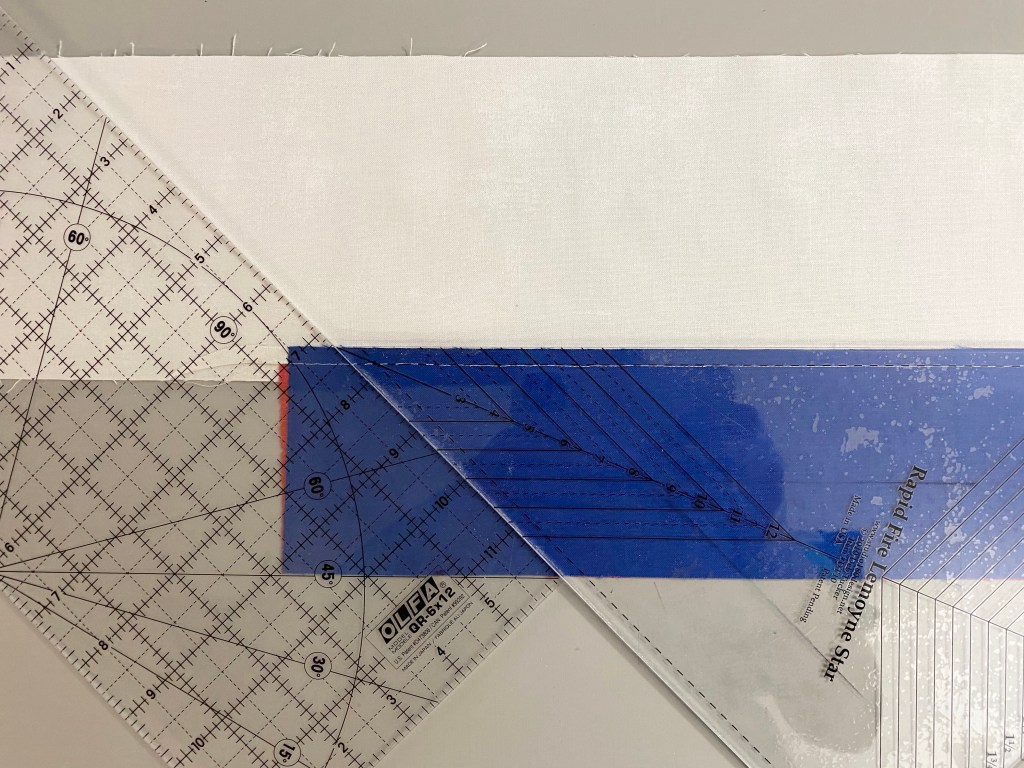
Step 6 – Cut: Make a 45 degree angled cut. Use your Lemoyne Star ruler to help insure you get a good 45 degree angle by lining up the ruler edge with the stitching line and bumping another ruler ap against the angled edge.
Step 7 – Cut the 1st Unit: Each Cut Should be the same measurement as the Star Strip Width (3 ¼” wide).
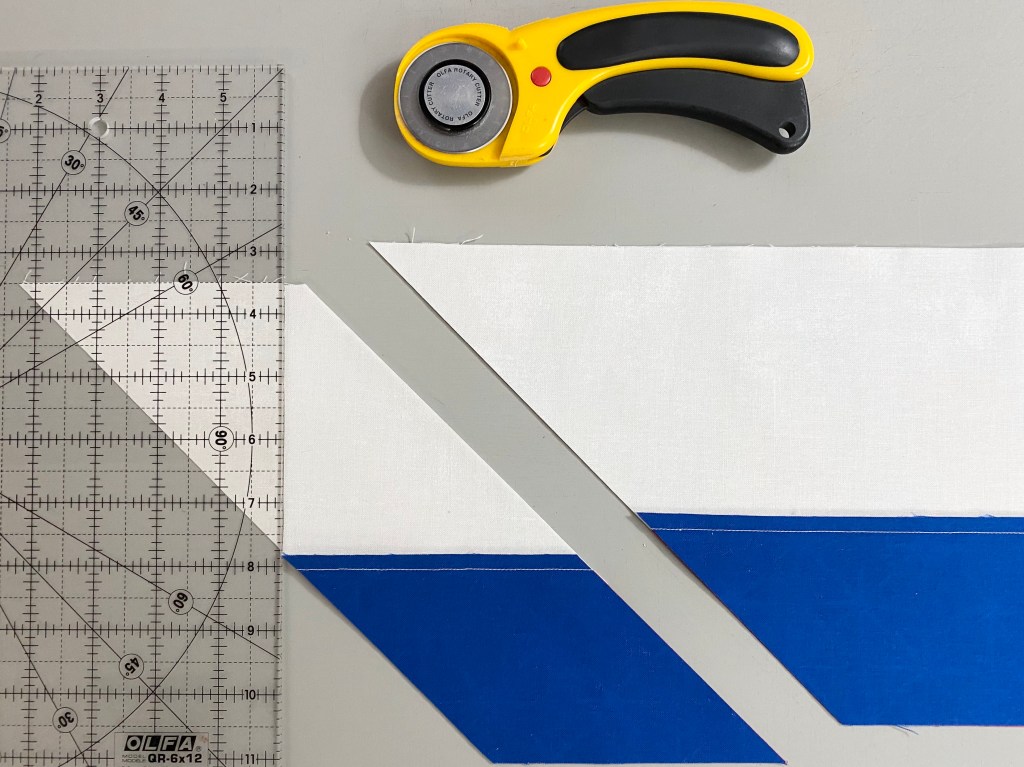
Step 8 – Second Cuts: Cut one set and trim side triangles. Using your 6” x 12” ruler, place a line on the top edge of the just cut unit and slide to the right until the ruler touches point from the star fabric. Trim up the right side of the ruler. See tool instructions for left hand cutting. In the tool instructions you are told cut all the units then trim the side triangles. I find the students are less confused if they cut the unit and immediately cut the side triangle.
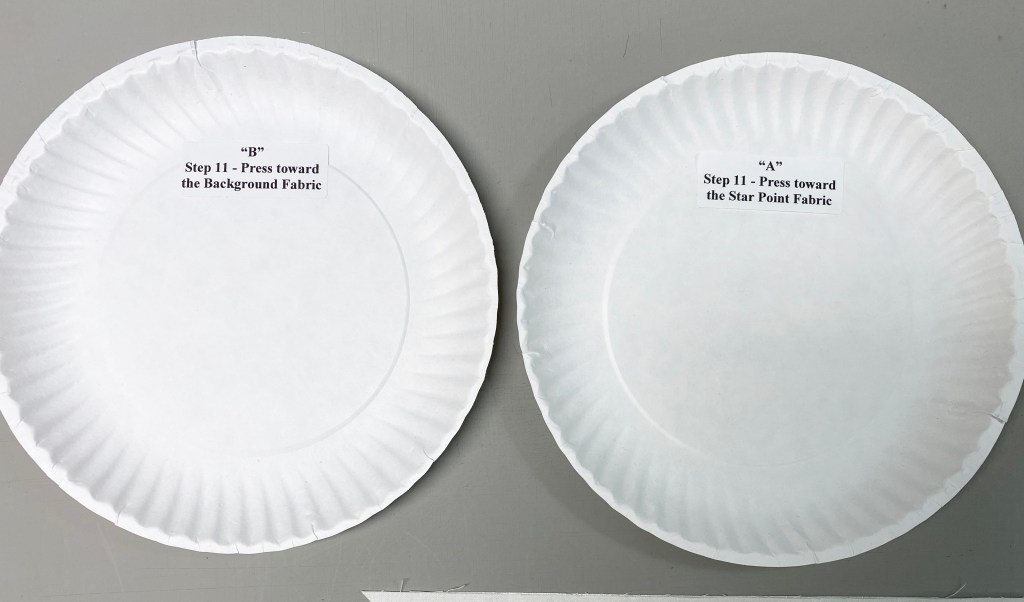
Tip: Label two paper plates One “A” & one “B”. I also add pressing instructions from Step 11: “A” units are pressed toward the star point. “B” units are pressed toward the background fabric.
Righties – “A” strip is on top & “B” strip is on the bottom. Once cut, place “A” unit on plate marked “A” & “B” unit on plate marked “B”.
Lefties – “B” is on top & “A” is on the bottom. Place “A” unit on plate marked “A” & “B” unit on plate marked “B”.
NOTE: IF Left Handed, It will be beneficial to flip each of the pairs over from east to west so that they look like the pairs trimmed by right handed cutters.
Cut side triangles and place one on each plate. Continue cutting sets and side triangles.
Step 9 – Lay Out: Take your plate of “A” units to the sewing machine.
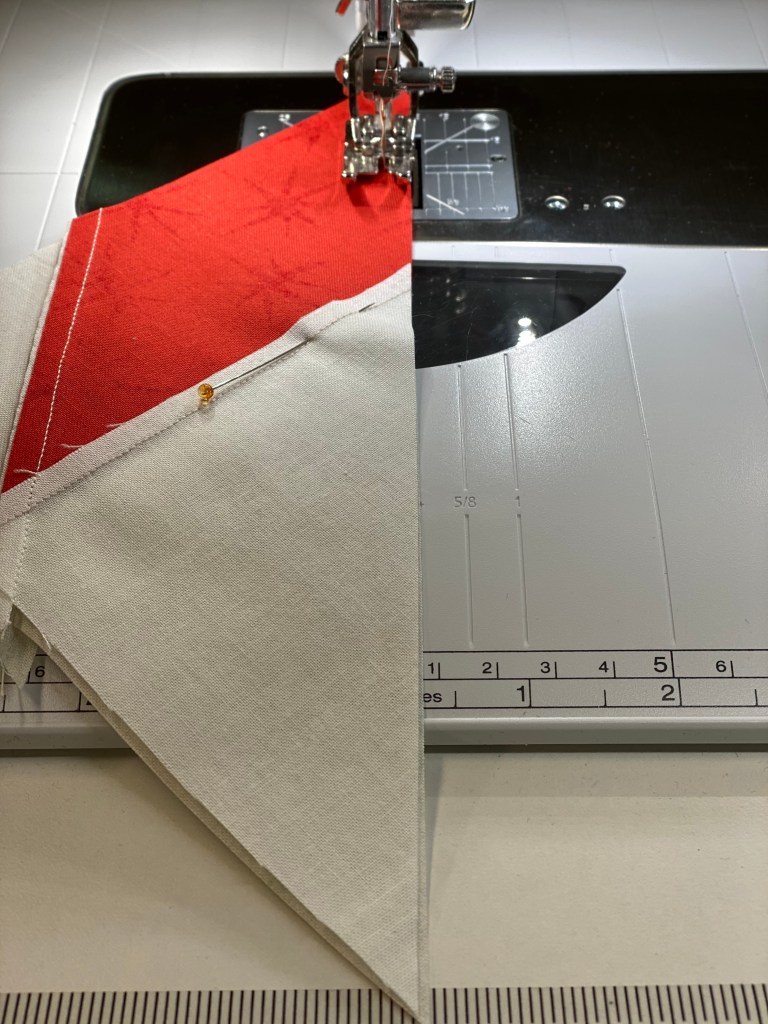
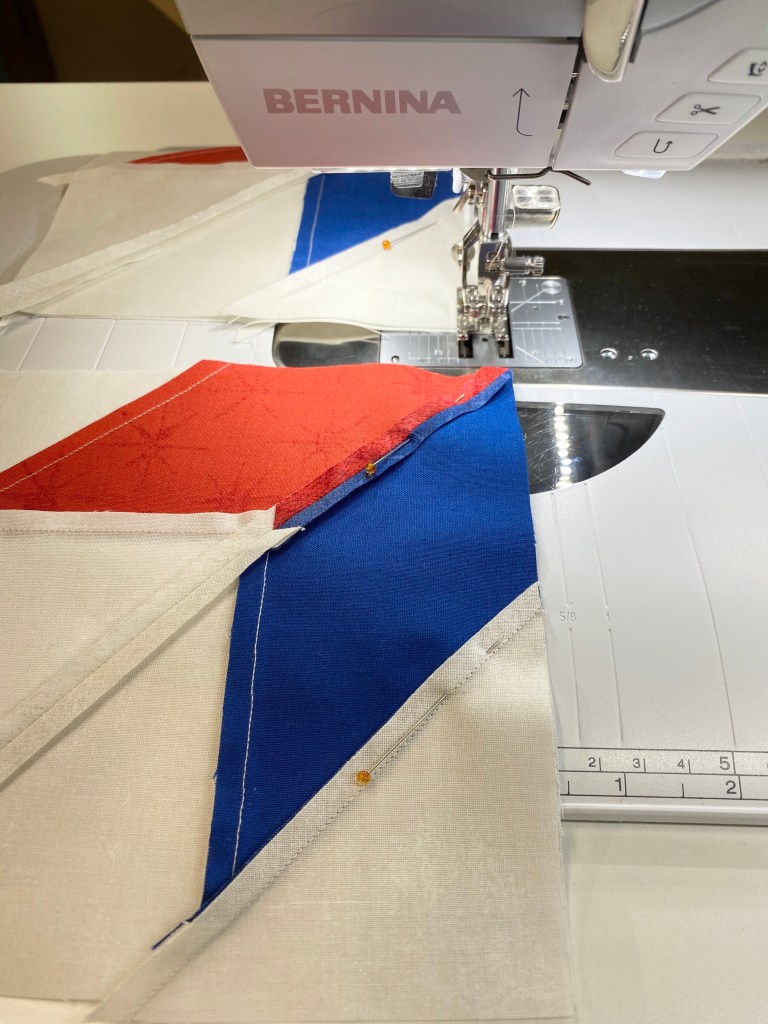
Step 10 – Position & Stitch: Position the side triangle right sides together with the pieced unit. Raw edges even and triangle centered over the pieced unit. Stitch, continue to chain stitch all the “A” units & then all the “B” units.
Step 11 – Press Carefully: Take the “A” units to the ironing board. “A” units are pressed toward the star points, therefore place your chain stitched units with the star points facing up. Trim threads, place back on “A” plate.
“B” units are pressed toward the background fabric, therefore place your chain stitched units with the background fabric facing up. Trim threads, place back on “B” plate.
STOP – BEFORE YOU TAKE ANOTHER STITCH!
Step 12 – Trim: Take all you units to the cutting mat. Place your units at a 2:00 position to be able to comfortable trim the two sides. Trim all your “A” & “B” units to an exact size using the 12” lines.
Step 13 – Examine/Position: You will now have pieced half square triangles that will fit together perfectly. Nest the seams and pin.
Step 14 – Stitch: Stitch the pieced triangle units together, first into pairs, then into half blocks and then into complete blocks. Stitch from the star center outward.
Step 15 – Press: Option #1 press all seams open. Option #2 press seam in the same direction as all the other seams in the unit. I press my seams open. Trim the Dog Ears at the star center.
Lay out four units.
Choose two units. Pin the nested seams and pin star point.
Press seams open.
Join halves pin the nested seams, match & pin the center. Stitch.
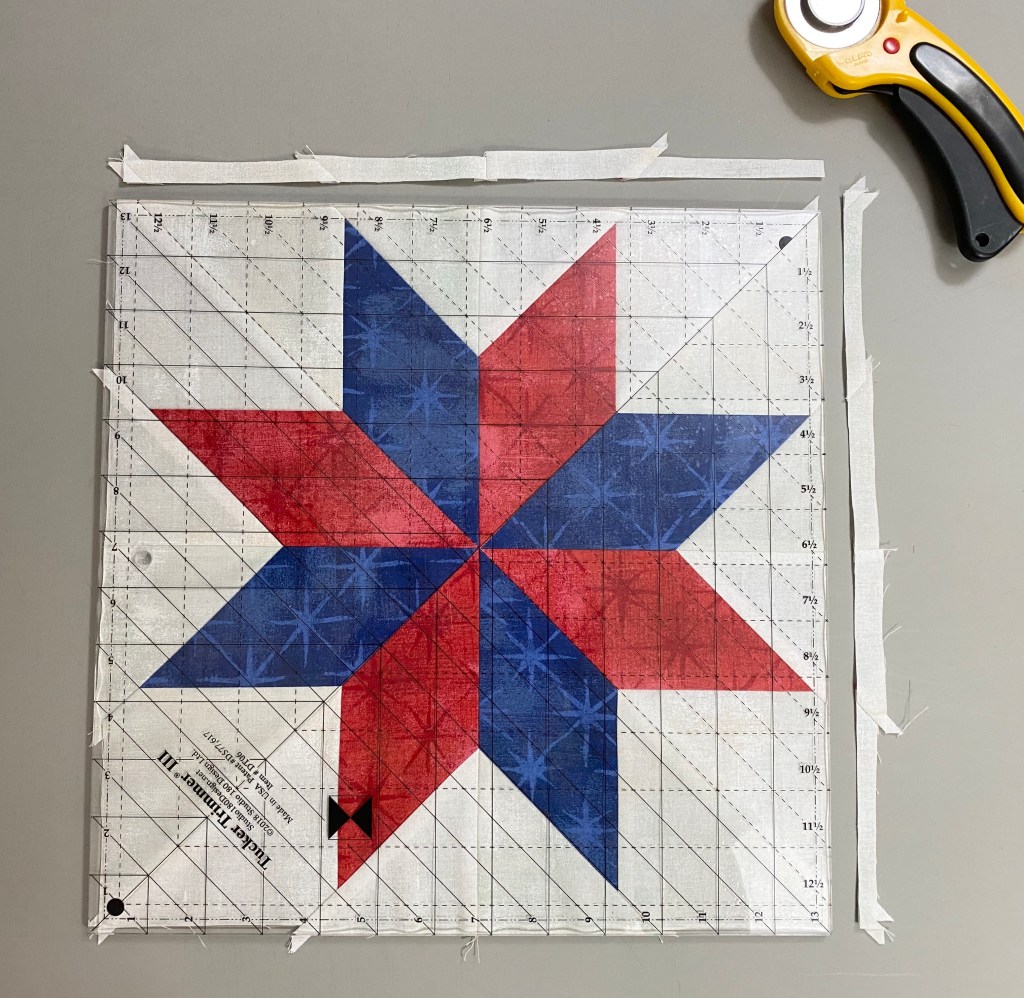
Step 16 – Trim to 12 ½” using your Tucker Trimmer III: If right handed, place the half circle in the upper right hand corner. Center the common diagonal line and the 12 ½”” size diagonal line on the seams of the block. Trim up the right side and across the top. Lift the tool, rotate the block, centering as before but also using the clean up lines on the edges just trimmed. Trim up the right side and across the top. See Tucker Trimmer tool instructors for complete left hand cutting.
Two WOF background strips & two WOF star strips will yield 2 – 12” finished lemoyne star blocks.
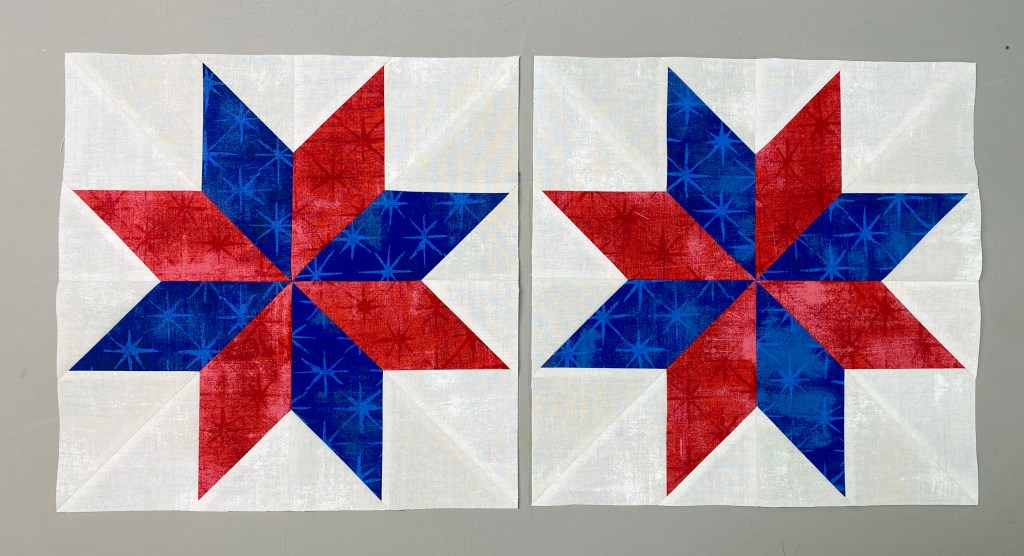
Twenty 12 ½” Lemoyne star blocks done!
Sashing: Cut 6 – 2 ½” WOF strips. Sub Cut into 16 – 12 ½” strips. I stitch four sashing strips between 5 blocks and measure the row length to determine the size of the vertical sashing strips.
Vertical Sashing: Cut 14 – 2 ½” WOF strips. You may need less if don’t mind piecing several together. I just stitched two 2 ½” WOF strips together and cut to fit. Once the vertical sashing is complete and rows are joined, measure the width through the center and cut the top and bottom sashing and stitch to the quilt top.
Cut 8 – 5 ½” WOF. Strips. Measure the length of the top to determine side border length. Once the side borders are stitched, measure the top width through the center to determine the final borders for the top and bottom.
Binding: You will need approximately 8 strips for the binding.
Welcome to the Quilt Qwazy Queens “Making Us Laugh Blog Hop”! I don’t know if I will make you laugh, but I hope I make you smile!
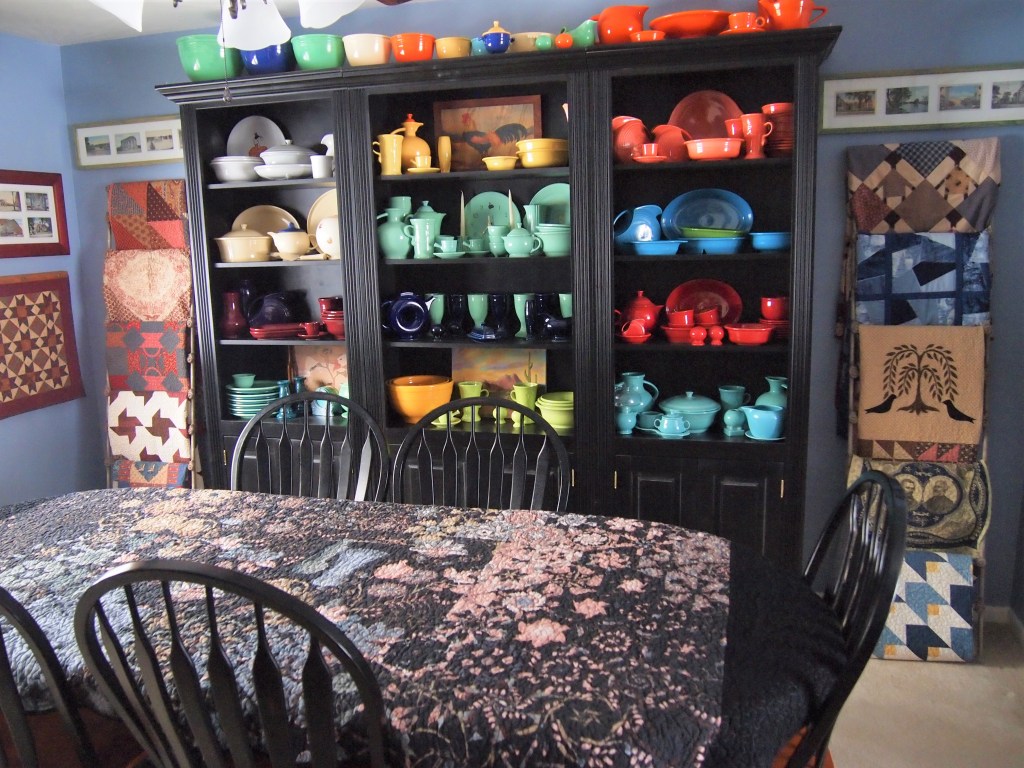
Some of my Fiesta collection.
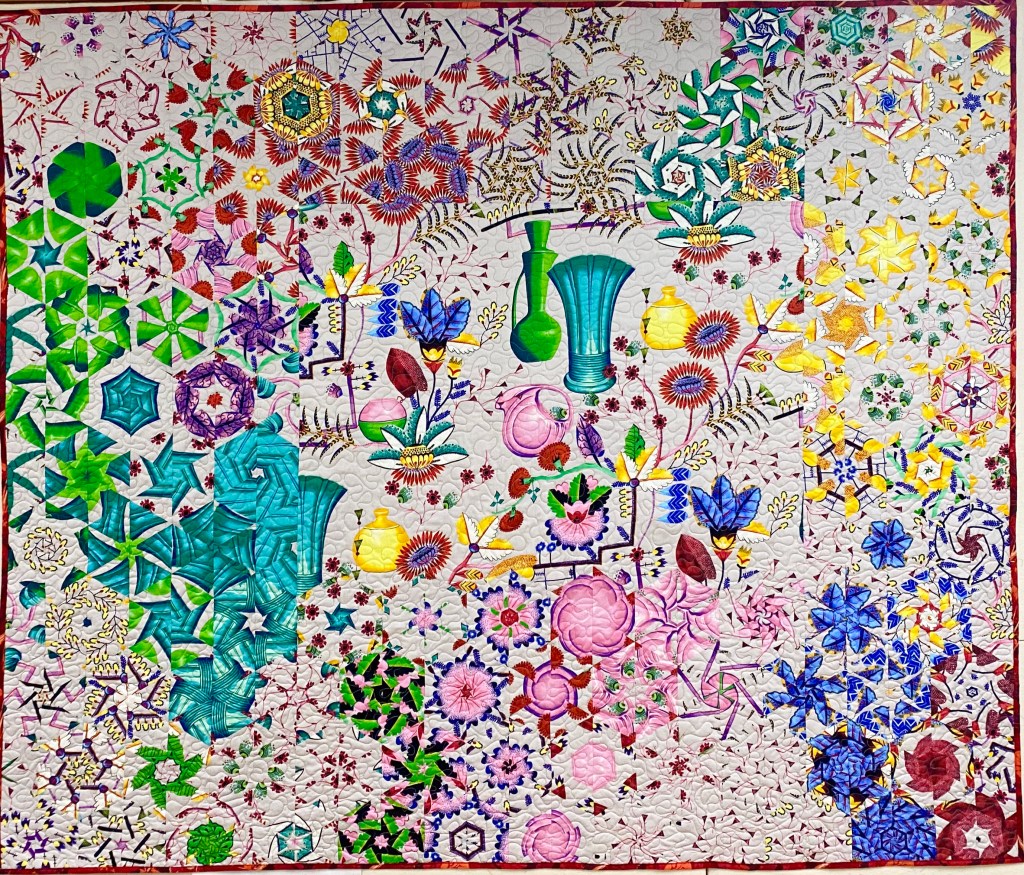
I bought this fabric by Alexander Henry in 3 colorways. It is called California, based on Fiesta dishware by Homer Laughlin.
OBW #59 Fiesta 1
Valance from Fiesta fabric
My contribution was to design a One Block Wonder around one repeat of fabric, and then speed it up! I’ve had this fabric for 5 years. Watch me design a OBW in 13 minutes.
I was entertaining my self with Facebook when I saw a post by my friend and fellow Studio 180 Design Certified Instructor, Karen Overton The Quilt Rambler. Here is some of what she wrote: “The idea began with a talented quilter named Jessica of Jessica Quilter also known on Instagram as @Jessicaquilter. Seems the good folks at Just Wanna Quilt picked up on her inspiration and ran with it! More details can be found here on the JWQ website. Jessica had an idea to use a little bit of her favorite fabrics from her “inventory” and the rest they say is history”. Karen was chosen as a Featured Designer, you can read the rest of The Quilt Rambler’s blog Inventory Quilt Project here.
I was inspired to check my “Inventory”
I had this wonderful collection by Tula Pink called Spirit Animal. I have had this fabric in my “Inventor” for over two years.
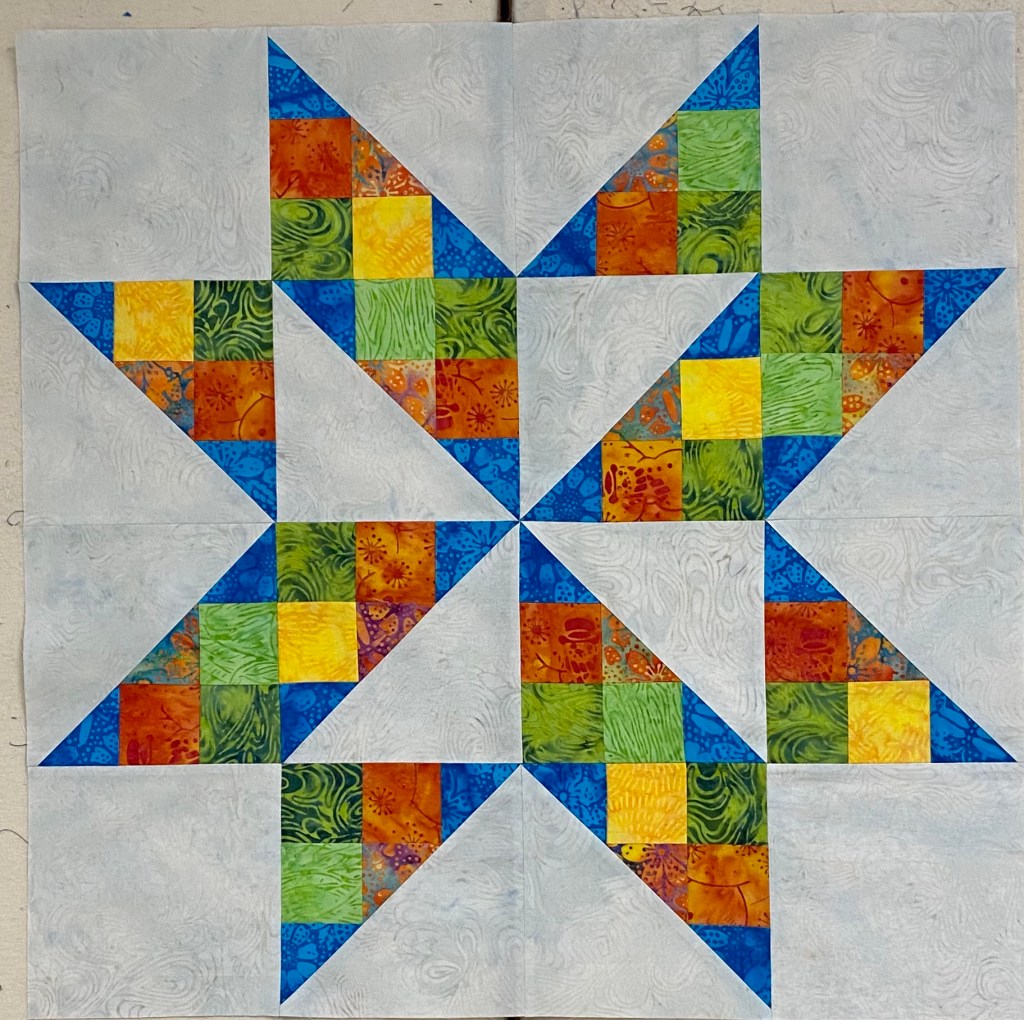
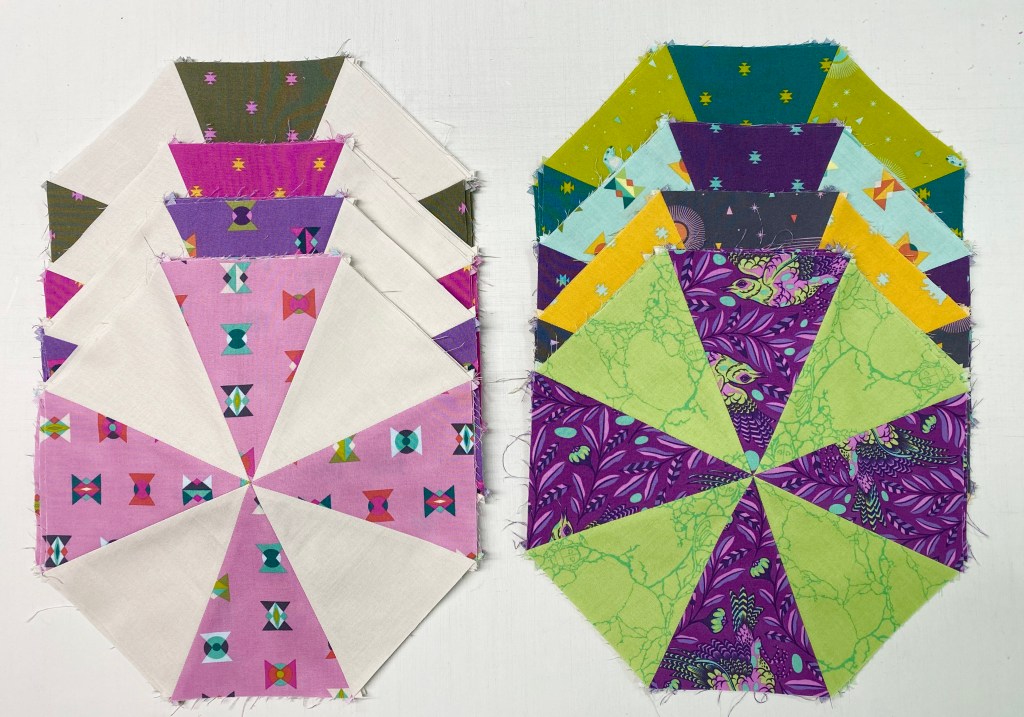
I decided to make Hallucination by Deb Tucker. This is a great pattern to get yourself acquainted with the Wedge Tool. You will also need a Tucker Trimmer III. To accomplish a scrappy Hallucination I had to put on my Rose colored glasses. I needed light, medium and dark fabrics. Whenever I have trouble sorting fabrics by value I use red lenses to help.
I began cutting my large wedges for Block “A” which consisted of medium and dark wedges.
Once the wedges are cut position a dark wedge with a medium wedge aligning the raw edges, being sure to always put the dark wedge on top. This will assure you will alternate between dark and medium wedges in your block. Stitch into pairs using your best 1/4″ seam allowance.
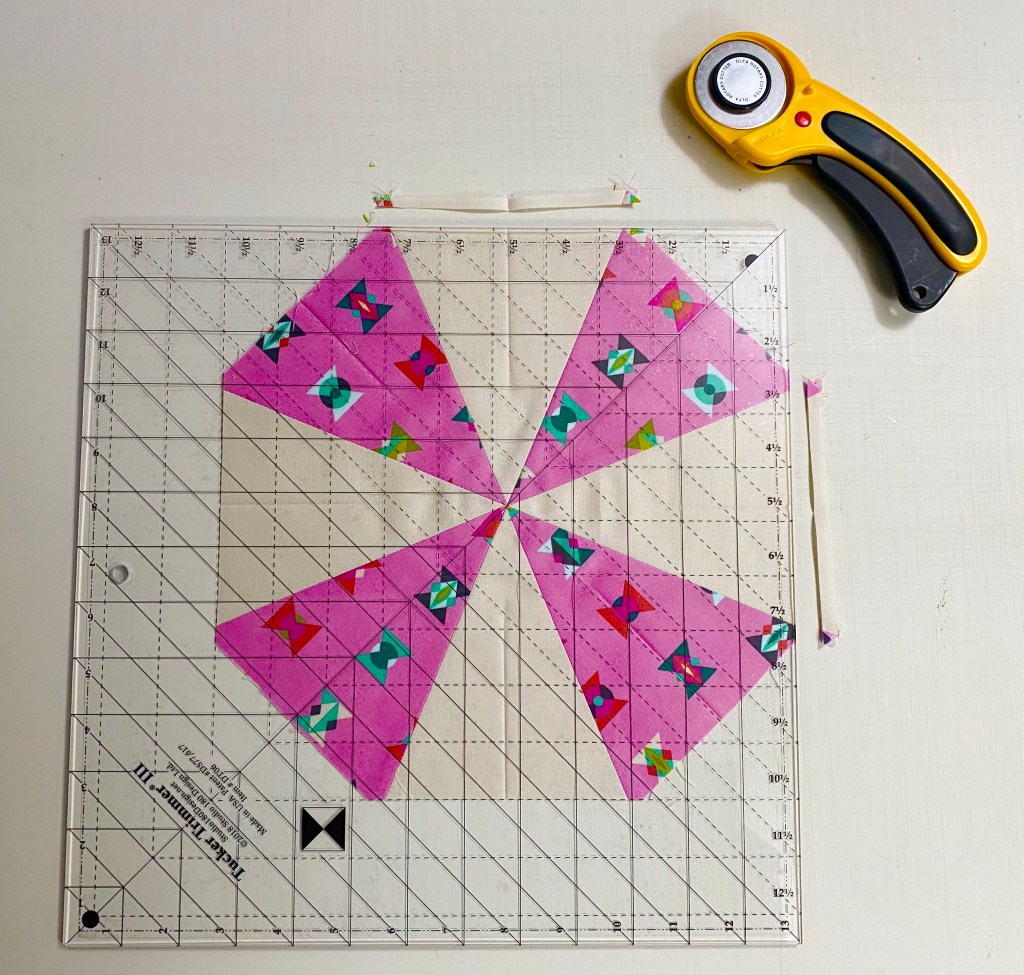
Remove the “dog ears” and “sliver trim” the wedge pair by aligning the common diagonal line on your Tucker Trimmer with the seam and trim the dog ears, and true up the 90 degree angle. Note there may be just a few whiskers trimmed here.
Continue for all the “A” Blocks and the “B” Blocks.
You need to make a halfway registration mark on all 8 wedges of all “A” & “B” Blocks. You can do this by placing the center line of the wedge tool on the seam and mark on the right side of the fabric with a removable marker. My thin chalk pen broke so I folded the wedges in half matching the seams and then pressed with my iron to give a centerfold line.
Block A: Position the dark wedges north, south, east and west on your cutting mat. Align the 10 1/2″ sizing line and the common diagonal line with the registration marks and the intersection of the lines with the center of the block. Trim up the side and across the top. Rotate realign and trim again. The dark wedges are trimmed so we can add corners to the block. The medium wedges will be trimmed after the corners are added.
Center the oversized corner triangles over the just trimmed dark wedges and stitch. Press toward the corner triangles.
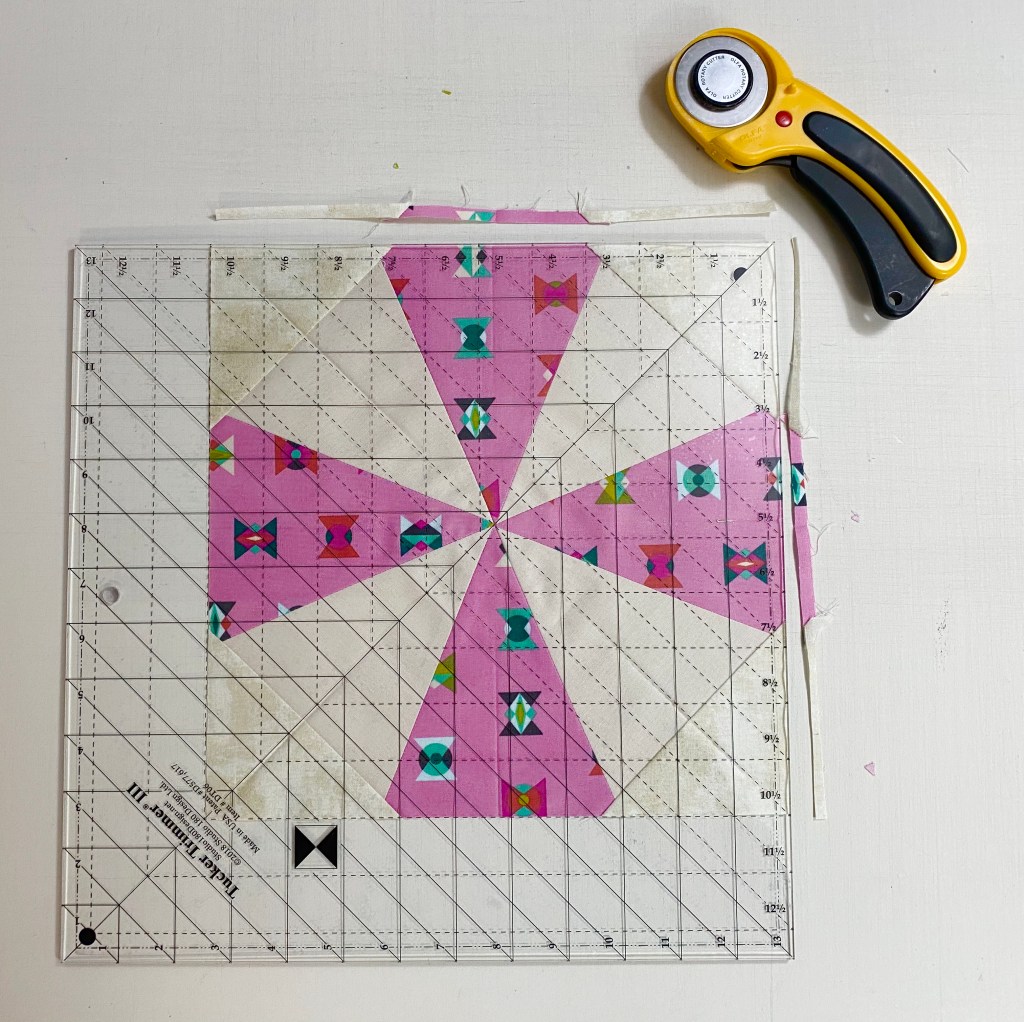
Using your Tucker Trimmer III, align the common diagonal and the 10 1/2″ sizing line with the registration marks and lines intersecting over the center of the block, trim up the side and across the top. Rotate the block and trim again.
Block B: Position the light wedges north, south, east and west on your cutting mat. Align the 10 1/2″ sizing line and the common diagonal line with the registration marks and the intersection of the lines with the center of the block. Trim up the side and across the top. Rotate realign and trim again. The light wedges are trimmed so we can add corners to the block. The medium wedges will be trimmed after the corners are added.
Center the oversized corner triangles over the just trimmed light wedges and stitch. Press toward the corner triangles.
Using your Tucker Trimmer III, align the common diagonal and the 10 1/2″ sizing line with the registration marks and lines intersecting over the center of the block, trim up the side and across the top. Rotate the block and trim again.
Block C:
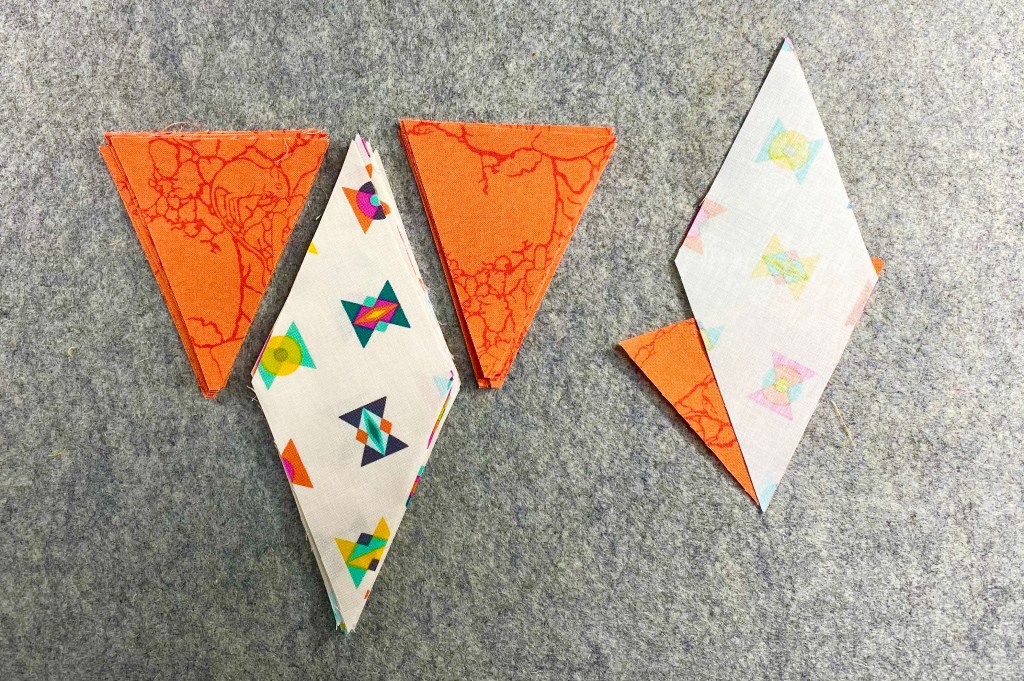
Cutting the Diamonds for Block C: Lay your strip horizontally on the cutting mat. Using your wedge tool align the edge of the Wedge Star tool with raw edge of the strip close to end of the strip. Using another ruler with a 45 degree line, bump it up to slanted edge of the Wedge Star tool, this helps to establish the 45 degree angle. Cut, keep cutting till you have the desired number of diamonds.
Lay out your small wedges and diamond units as shown. Position a small wedge from the right hand side of the top of the diamond. Match the point of the diamond with the corner of the wedge and align the raw edges.
Stitch with the diamond on top.
Press toward the diamond. Remember “whatever you are pressing toward, goes on top”!
Trim off the dog ear. Position a remaining small wedge to the other side of the diamond point. Align the raw edges and center the shapes right sides together. Press toward the small wedge. Trim the each diamond wedge using the 10″ line in the Diamond Trim Down Section on the Wedge Star tool.
Lay out the Diamond Wedges and the dark Large Wedges for the C Block.
Consistently place a diamond Wedge on top of a dark Large Wedge right sides together.
Stitch the point end first. Press seams open. Trim the dark wedges as before and add the triangle corners. Trim the block with your Tucker Trimmer III.
In fact be sure you press all seams open during block construction. I find the Strips Stick very helpful!
Lay out your finished A, B & C blocks, stitch into rows. Add your inner and outer Borders.
I’m loving this scrappy version of Hallucination!
This project was Tucker approved with Aurifil Thread, Quilters Dream Batting, my Reliable Iron, and the Strip Stick. Not to mention my wonderful Studio 180 Design Tools.
























































 If These Threads Could Talk